
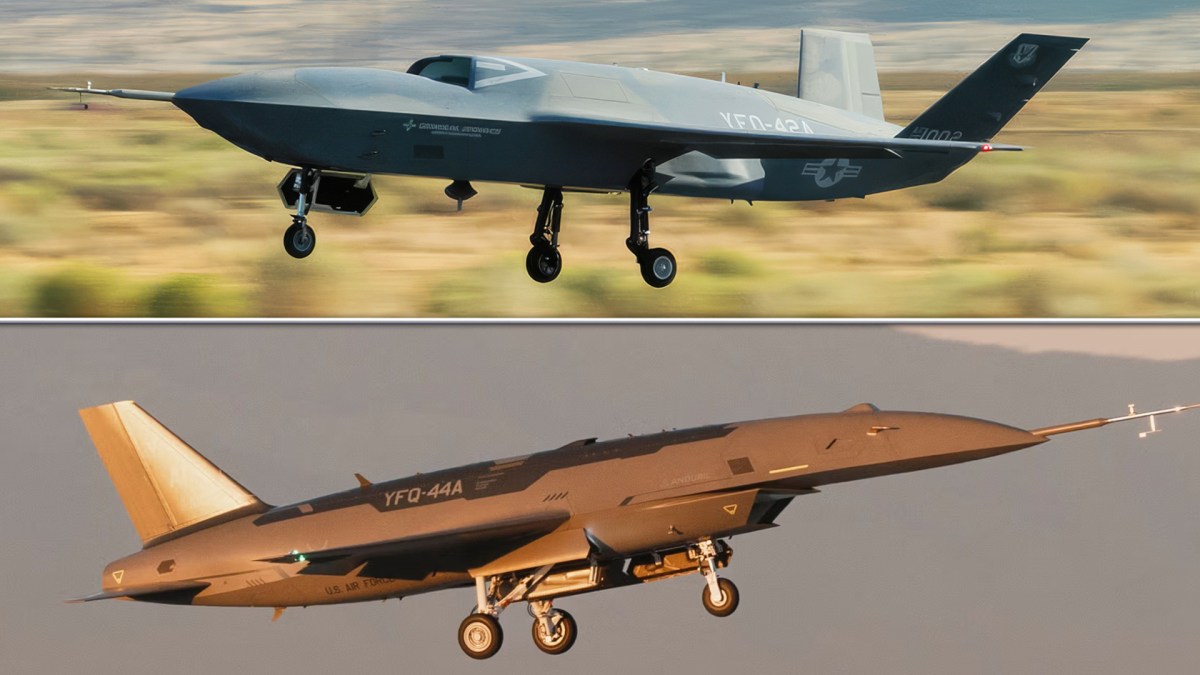
The U.S. Air Force awarded production contracts for its Collaborative Combat Aircraft program to both General Atomics and Anduril on June 18, 2026 — a dual-award decision that keeps both competing designs alive rather than selecting a single winner. General Atomics' FQ-42 and Anduril's FQ-44 will proceed into production in parallel, with the contract structure reflecting that CCA remains a high-risk program despite clearing the development phase. In a separate but related action, a three-company team of Anduril, Shield AI, and Collins Aerospace was selected to develop the autonomous systems software that will govern CCA operations.
These awards represent the first Collaborative Combat Aircraft designs to formally enter production, marking a genuine program phase transition with industrial, doctrinal, and technical implications for the defense aerospace sector. The trajectory of CCA as a manned-unmanned teaming capability also carries relevance for communications infrastructure — including the space-based connectivity architecture that the Space Development Agency is currently building out.
A Dual-Vendor Strategy Designed for Risk, Not Just Competition
The choice to fund both the FQ-42 and FQ-44 into production simultaneously carries a specific programmatic rationale. The War Zone characterized CCA as still a "high-risk program," and the dual-award structure is directly responsive to that assessment★. By keeping two distinct airframe designs in production, the Air Force insulates itself against single-point failure★: if one design encounters significant development or manufacturing problems, the other remains on track to deliver at least partial capability on schedule. The approach also preserves competitive pressure on both contractors as production lines mature and unit costs come into focus.
This strategy is more expensive in the near term than a winner-take-all selection would be. Two separate production programs require two supply chains, two manufacturing footprints, and two distinct quality management systems★. The Air Force's implicit judgment is that program-level risk reduction justifies the overhead, at least until each design has accumulated enough flight test and production data to support a more definitive comparison. Whether the service eventually converges on a single type, adjusts production volumes significantly between the two, or maintains both indefinitely will depend on performance outcomes that are not yet available.
Both firms now face the operational realities of production: supply chain development, workforce scaling, and the cost and schedule discipline that procurement programs demand.
The Autonomy Stack: Decoupled, Portable, and Shared
The selection of Anduril, Shield AI, and Collins Aerospace to develop the CCA autonomy system is structurally the most significant architectural decision embedded in these awards, because it separates the AI and autonomy layer from the airframe manufacturers entirely. By holding the autonomy stack in a distinct contract with a separate team, the Air Force retains the flexibility to evolve, update, or ultimately replace the AI software independently of the physical aircraft★ it runs on — avoiding vendor lock-in that would result from each airframe contractor developing proprietary autonomy software tied to its own design.
The shared autonomy layer means both the FQ-42 and FQ-44 will operate under the same underlying AI architecture★. That simplifies the Air Force's manned-unmanned teaming integration challenge and avoids the complications of managing two incompatible autonomy frameworks across what would otherwise be a split fleet.
Anduril's dual role — as both the FQ-44 airframe contractor and a member of the autonomy development consortium — is the arrangement that merits the most ongoing attention. The company simultaneously holds a production contract for a competing vehicle design and participates in building the software stack that will also be evaluated against General Atomics' aircraft. How the Air Force structures the information boundaries and conflict-of-interest provisions within this arrangement will be a recurring point of scrutiny as the program matures. The involvement of Shield AI and Collins Aerospace alongside Anduril suggests the service sought to distribute autonomy development risk and expertise across multiple organizations rather than relying on a single software prime★.
The autonomy system's operational purpose — enabling CCAs to act as genuine collaborative wingmen through coordinated, sensor-informed decision-making with crewed aircraft — places high demands on the underlying communications architecture. Manned-unmanned teaming at scale requires low-latency, high-bandwidth, resilient data links both within and beyond line of sight, and that connectivity requirement links directly to what the Space Development Agency is building.
SDA Transport Layer Advances as Tactical Connectivity Architecture Matures
Approximately one month after the CCA production awards★, SpaceX successfully launched the SDA Tranche 1 Transport Layer E mission on a Falcon 9 from Space Launch Complex 4E at Vandenberg Space Force Base on July 16, 2026. The satellites reached polar orbit and represent one of six planned missions under the Space Development Agency's Tranche 1 build-out of the Proliferated Warfighter Space Architecture's Transport Layer. The mission was listed as Government/Top Secret, limiting publicly available detail on payload configuration.
For satcom and space-sector professionals, the Tranche 1 Transport Layer E launch is significant on its own terms.
The sources reviewed for this briefing do not directly connect the CCA production contracts to specific PWSA connectivity requirements — that linkage, if formalized in acquisition planning, has not been made public. What can be said is that both programs are advancing simultaneously, and that the communications demands of large-scale autonomous air operations will eventually need to be met by infrastructure that space-based architectures like PWSA are positioned to provide.
Near-Term Milestones
With production contracts in hand, the immediate priorities for General Atomics and Anduril are manufacturing ramp-up, supply chain development, and integration of the shared autonomy stack into production-representative aircraft.
Flight testing with production-configuration FQ-42 and FQ-44 aircraft will be the next major technical milestone to watch. Those results will generate the performance data the Air Force needs to calibrate how the two designs compare against operational requirements and how the shared autonomy system performs across both airframes — data that will directly inform longer-term decisions about production volumes and whether the dual-vendor structure remains the appropriate approach as the program scales.
For the SDA, the remaining Tranche 1 Transport Layer missions represent the near-term delivery schedule to monitor, with the density of the completed Tranche 1 constellation establishing the baseline from which Tranche 2 will build.
★ AI inference: One or more analytical conclusions in this article were drawn by the AI from cited facts and are not directly stated in the cited sources.