
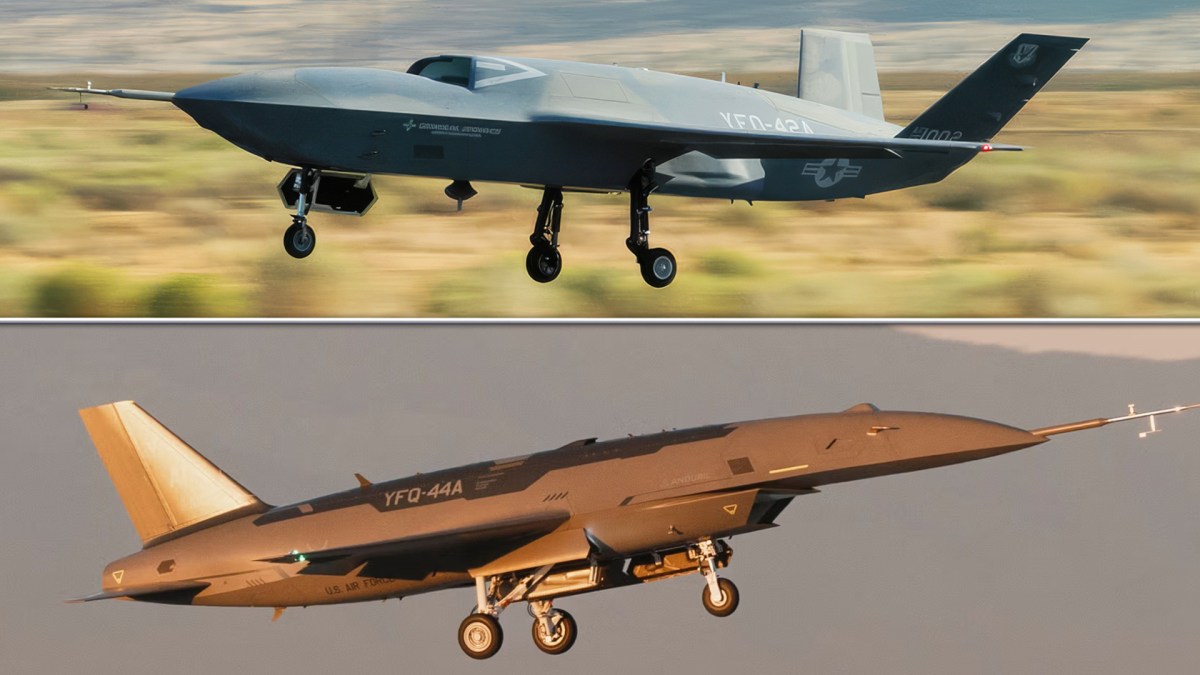
The U.S. Air Force has awarded production contracts to General Atomics and Anduril for its first Collaborative Combat Aircraft (CCA), clearing both designs for manufacturing and advancing the service's vision of AI-driven autonomous wingmen flying alongside crewed fighter jets★.
The contracts, announced June 17–18, 2026, green-light two distinct airframes: General Atomics' FQ-42 and Anduril's FQ-44. A separate team composed of Anduril, Shield AI, and Collins Aerospace has been tapped to develop the autonomy system that will govern how the aircraft operate in concert with manned platforms★.
A Deliberate Dual-Award Strategy
Rather than selecting a single winner — the conventional endpoint of a major defense competition — the Air Force chose to fund both designs into production simultaneously. Reporting by The War Zone notes that purchasing both CCA designs carries meaningful advantages for what remains a high-risk program. Retaining two airframe contractors preserves optionality: if one design encounters technical or integration problems, the other continues on a parallel track★. The approach reflects institutional recognition that autonomous crewed-uncrewed teaming, however promising, is not yet a solved problem★.
Two Contractors, Complementary Backgrounds
The pairing of General Atomics and Anduril is notable in its range.
What Comes Next
The production awards mark a transition from the development and demonstration phase to actual manufacturing★, though the CCA program as a whole remains in relatively early stages and carries inherent risk★.
★ AI inference: One or more analytical conclusions in this article were drawn by the AI from cited facts and are not directly stated in the cited sources.