
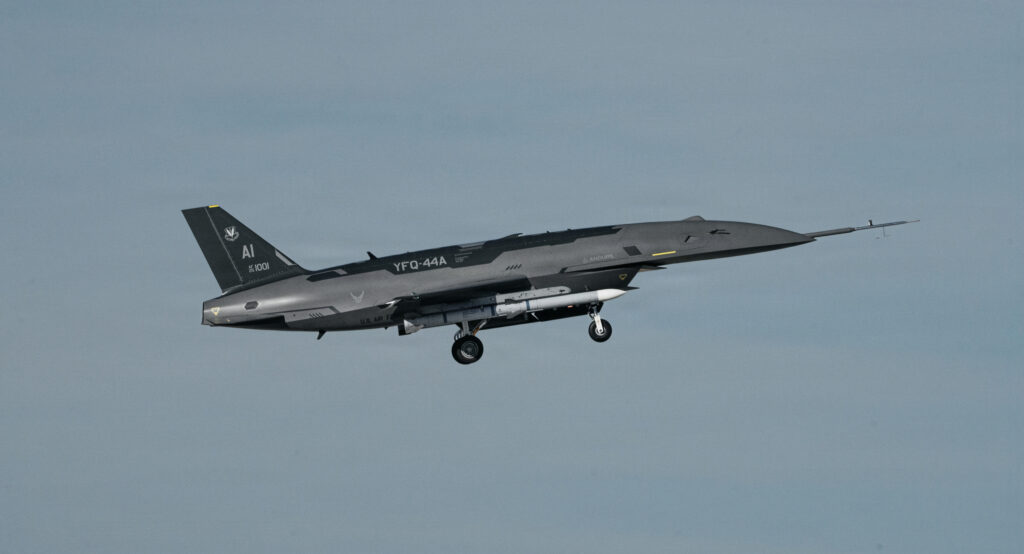
The U.S. Air Force has crossed a threshold that defense analysts have long anticipated: a live air-to-air missile launched from an autonomous wingman drone. The test, confirmed publicly by Air Force Chief of Staff Gen. Kenneth Wilsbach, involved an AMRAAM fired from a Collaborative Combat Aircraft — the service's emerging family of unmanned platforms designed to fly alongside crewed fighters in a teamed formation.
Wilsbach's framing of the event was notably expansive. According to Breaking Defense, he indicated the significance of the shot went beyond the mechanical act of releasing a missile, signaling that the test validated deeper integration between the autonomous platform and the broader combat system around it★. That framing matters: a drone successfully carrying and releasing a weapon in a controlled environment is one thing; demonstrating that the release fits within an operational command-and-control architecture is another.
What the Test Represents
Moving CCA from a concept defined largely by airframe development and autonomy software into something that functions as an armed node in a real combat workflow.
The test also sharpens questions that have trailed the CCA program since its inception. As autonomous platforms gain the ability to release lethal ordnance, the chain of command authority becomes more complex. How much discretion does the system exercise, and at what point in the targeting sequence does a human authorize release? But the mechanics of that oversight in a high-tempo, contested-airspace scenario are not yet publicly detailed.
Escalation and the Road Ahead
The milestone arrives. A live weapon release demonstrates that at least one piece of that vision — armed autonomous teaming — is no longer theoretical.
Escalation control is the harder problem. In a peer conflict where decision timelines compress and electronic warfare degrades communications, the boundary between human-in-the-loop and human-on-the-loop authority can blur rapidly. The Air Force's ability to articulate clear rules of engagement for armed autonomous platforms will be as important to the program's future as the engineering achievements themselves.
For now, the confirmed AMRAAM shot establishes that a CCA can carry, integrate, and successfully fire a live weapon — a requirement any operational platform must meet before it can be seriously evaluated for deployment. The next questions are about scale, doctrine, and the degree of autonomy the service is prepared to extend as these platforms move from test ranges toward contested skies.
★ AI inference: One or more analytical conclusions in this article were drawn by the AI from cited facts and are not directly stated in the cited sources.