
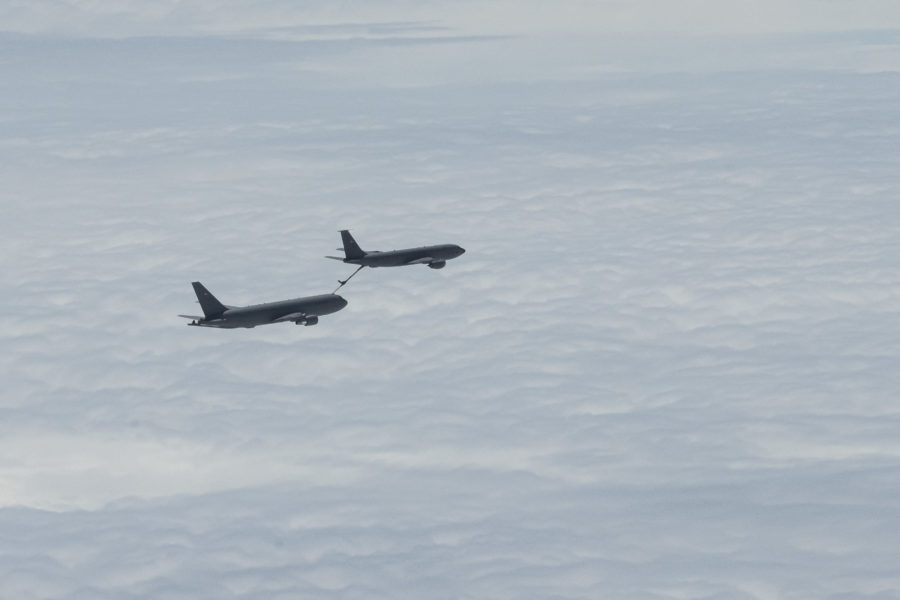
The U.S. Air Force has begun fitting KC-46 Pegasus refueling aircraft with beyond-line-of-sight (BLOS) connectivity, a meaningful shift in how Air Mobility Command approaches networked warfare. The upgrades, which include Link 16 data-link systems for enhanced battlefield awareness, mark the latest step in a deliberate, long-term effort to close the capability gap between support aircraft and the fighter and bomber fleets they serve.
For decades, advanced tactical data links and real-time battlespace awareness tools were largely confined to combat aircraft. Tankers and airlifters operated in a comparatively information-sparse environment, relying on voice communications and limited situational data. AMC's modernization push changes that calculus by treating connectivity itself as a survivability asset. As one Air Force official was quoted as saying, survivability "starts with being connected so that you have battlespace awareness."
Upgrades Spanning Both the KC-46 and KC-135
The effort is not limited to the newer KC-46. The older KC-135 Stratotanker fleet is also being brought into the networked force on an accelerated timeline, with the Air Force setting a six-year deadline for connectivity upgrades across that aircraft. Funding covers 315 hybrid satellite communications terminals and approximately 240 Ku-band array antenna kits for KC-135s, with comparable hardware being installed on KC-46A aircraft in parallel. A KC-135 was recently observed sporting a new, large satellite communications antenna — physical evidence that the program is progressing from procurement into actual fleet modification.
The combination of hybrid satellite communications terminals and Ku-band arrays suggests a layered approach: high-bandwidth satellite links for data-heavy communications and the resilience to operate in contested or degraded environments where traditional line-of-sight radio links may be unavailable or jammed.
Bridging the Connectivity Gap
The strategic logic is straightforward. Modern air operations depend on shared tactical pictures, and a tanker orbiting near a contested airspace that cannot receive or transmit threat data is a liability as much as an asset. By equipping refuelers with Link 16 and BLOS communications, the Air Force enables tanker crews to see what the fighters they are supporting can see — and to reposition or respond before adversary threats close in.
This also has implications for command-and-control resilience. Tankers and airlifters that can relay data across a network expand the number of nodes available to pass information, reducing dependence on any single communications pathway. In a large-force employment scenario against a peer adversary, that redundancy matters.
AMC's push reflects a broader service-wide recognition that support platforms can no longer be treated as operating in a permissive rear area. The upgrades being fielded now are a foundation — establishing baseline connectivity from which additional capabilities, such as integrated air and missile defense data or dynamic retasking, could eventually follow.