
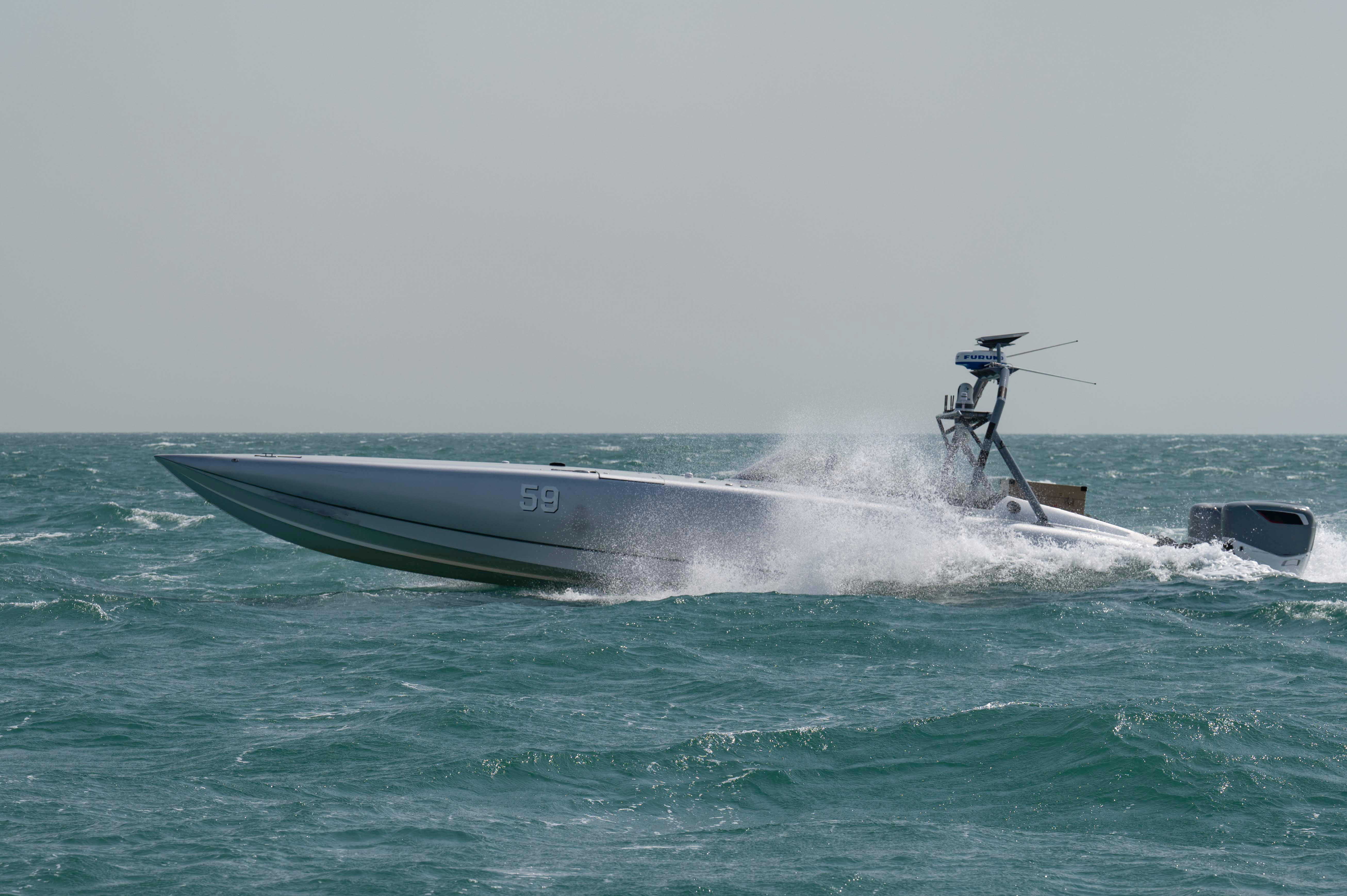
The U.S. Department of Defense has formally issued a competition seeking unmanned surface vessels (USVs) capable of carrying and launching aerial attack drones, signaling an accelerated effort to field distributed maritime strike capability without waiting for new platforms to be designed from scratch.
The program, run by the Defense Innovation Unit (DIU), is called the Suitable Warfighting Adaptive Payloads challenge — or SWAP-USV. It is structured as a three-phase, yearlong prize competition with a total value of up to $100 million. Submissions for the first round are due August 10, and selected contractors are expected to have systems ready for testing within 120 days of award.
What the Challenge Demands
DIU is explicitly requiring market-ready, mature technology rather than development-stage concepts. Each submission must bundle a capable USV with at least two mature aerial drones that are fully integrated with the vessel. The solicitation specifies intercept capabilities as part of the intended mission set, pushing the requirement beyond passive surveillance toward active maritime engagement★.
The insistence on market-ready systems is itself a strategic signal. Rather than funding lengthy development cycles, the Pentagon is attempting to rapidly assess what the commercial and defense industrial base can already field. The compressed 120-day testing window reinforces that the program is oriented toward speed over customization.
Convergent Coverage Reflects Broad Interest
The solicitation drew simultaneous coverage from multiple defense publications — Defense News, Military Times, and Air Force Times — on July 29, 2026. It is worth noting that these three outlets are part of the same media group and ran the same report★; they represent wide readership across different service communities rather than three independent investigations of the program. Separate reporting from InsideDefense and GovCon Wire confirmed the program's structure, phased timeline, and $100 million budget ceiling.
The SWAP-USV challenge reflects a continuing Pentagon push to extend uncrewed systems into maritime strike roles, compressing the traditional acquisition timeline to get capable platforms into testing as quickly as possible.
★ AI inference: One or more analytical conclusions in this article were drawn by the AI from cited facts and are not directly stated in the cited sources.