
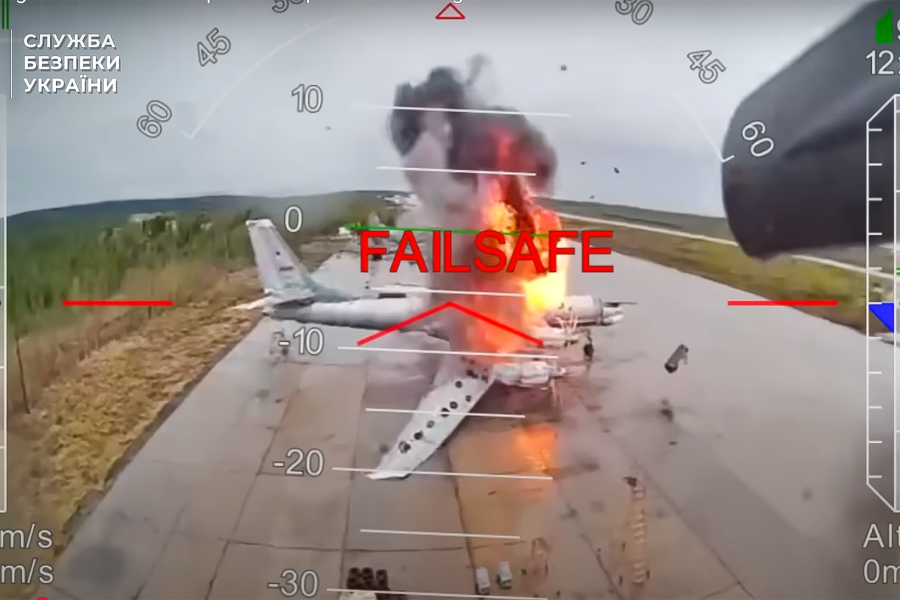
Retired Air Force Gen. Glen D. VanHerck, who led U.S. Northern Command and NORAD before his retirement, publicly warned on July 30, 2026 that domestic U.S. air bases remain exposed to the kind of coordinated drone assault Ukraine demonstrated in Operation Spiderweb — an attack that successfully struck Russian bomber bases hundreds of miles behind the front lines★. VanHerck's concern is pointed: heavy base security perimeters, while significant, may not be sufficient to defeat a sophisticated, multi-drone swarm designed to overwhelm defenses through sheer coordination and volume.
Operation Spiderweb provided adversaries and analysts alike with a real-world proof of concept. VanHerck's argument is that U.S. installations — including those on the homeland — face an analogous risk from peer or near-peer state actors who have studied the same playbook.
A Warning Years in the Making
What makes VanHerck's July 30 statement particularly striking is that it is not a new alarm. The gap between that early warning and the current state of homeland air-base defense is, by implication, the accountability question his remarks raise.
VanHerck is not alone in this assessment. Brig. Gen. Houston Cantwell (USAF, Ret.), a senior resident fellow for airpower studies at the Mitchell Institute for Aerospace Studies, stated in late July 2026 that the United States faces serious drone risk not only in expeditionary operations overseas but on home soil as well. Cantwell has argued that current U.S. counter-drone capabilities fall well short of what would be needed to reliably defeat a determined drone campaign★ — a gap that VanHerck's warning reinforces.
Implications for Force Protection
The convergence of these warnings points to a structural problem in U.S. force protection doctrine. Bases designed to guard against vehicle-borne threats, perimeter intrusions, or traditional air attack are not necessarily configured to detect, track, and defeat dozens of small, low-flying drones arriving simultaneously from multiple vectors.
For U.S. military readiness, the stakes are significant. A successful strike on even one major air base — damaging aircraft, runways, fuel systems, or maintenance facilities — could degrade sortie generation capacity at a moment of crisis★. VanHerck's framing of the threat as proven rather than theoretical, grounded in what Ukraine actually accomplished against Russia, gives the warning an urgency that years of classified briefings apparently did not fully translate into policy action★.
★ AI inference: One or more analytical conclusions in this article were drawn by the AI from cited facts and are not directly stated in the cited sources.