
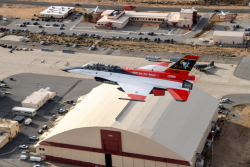
The U.S. Air Force announced on August 4–5, 2026, that its X-62 VISTA autonomous test fighter had conducted 27 artificial intelligence-controlled intercepts of crewed aircraft across eight flights earlier in the year.
Rather than relying on ground-controlled inputs or pre-scripted maneuvers, AI agents processed targeting data from a Legion Infrared Search and Track (IRST) pod mounted on the aircraft and used that sensor feed to independently execute each intercept. The use of an operational sensor — rather than a purpose-built test instrument — is significant★: it suggests the underlying architecture could translate more directly to fielded platforms than earlier laboratory-style demonstrations★.
What the Tests Do and Don't Show
The experiments were explicitly framed as controlled proof-of-concept work, not operational deployments★. Conducting intercepts against live airborne targets in a structured test environment is a long way from autonomous engagement in a contested, dynamic battlespace. Still, the scale of the effort — 27 intercepts over eight flights — indicates the Air Force is moving well past single-event demonstrations and into repeatable, data-rich experimentation.
If an AI agent can reliably cue on a sensor return, compute an intercept geometry, and prosecute it without human intervention in controlled conditions, the doctrinal question shifts from whether the technology is feasible to how and under what rules of engagement it might eventually be authorized. Those questions — about human oversight, escalation risk, and legal accountability in autonomous engagements — remain unresolved and were not addressed in the August announcements.
The 2026 IRST-guided intercept series extends that lineage into a more sensor-realistic regime, closing some of the gap between laboratory autonomy and the kind of sensor-fused environment real combat aircraft operate in.
Lockheed Martin's Skunk Works, which has been central to the X-62 program, characterized the results as an advance in sensor-powered AI fighter intercept capability★ — language that points toward eventual integration with production-representative avionics rather than one-off research hardware★.
★ AI inference: One or more analytical conclusions in this article were drawn by the AI from cited facts and are not directly stated in the cited sources.