
The U.S. Space Force marked a dense stretch of activity this week, announcing two substantial commercial contracts while satellite maker Astranis simultaneously unveiled a new product aimed squarely at geostationary surveillance—a combination that illustrates the military's broadening push for orbital agility and awareness in contested space.
Two Contracts, Two Capabilities
Space Kinetic secured a $50 million Other Transaction Authority award from the Space Force to advance Whirlwind, its space maneuverability and deployment system. The award was announced August 13, 2026.
A day earlier, Impulse Space received a $28 million expansion to an existing contract, adding two more vehicles—designated Victus Salo 2 and 3—to a line already tasked with responsive-space maneuvering demonstrations. The Victus program is explicitly oriented around rapid, on-demand orbital operations★, and the follow-on order suggests the earlier work met expectations★. Together, the two awards total $78 million spread across distinct vendors.★
Astranis Adds a Surveillance Dimension
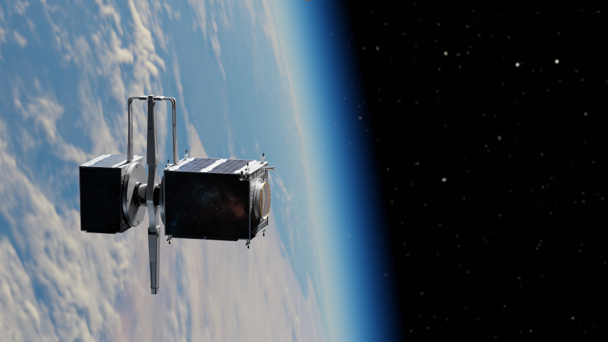
On the same day as the Space Kinetic announcement, Astranis unveiled Perceptor—a geostationary spacecraft designed to inspect, track, and maneuver around other satellites operating in GEO. The company described the product as born from operational experience: while running its own MicroGEO communications satellites, Astranis identified gaps in existing space domain awareness tools in the geostationary belt and built Perceptor to address them.
Perceptor is a commercial product announcement rather than a confirmed government contract.★
A Pattern, Not a Coincidence
The near-simultaneous release of these three announcements is unlikely to be accidental. The Space Force has been deliberately cultivating a commercial industrial base capable of executing on-orbit servicing, maneuvering, inspection, and rapid deployment—capabilities grouped under the broader concept of space superiority.
The contracts and product announcements this week reflect an industrial base that is, at minimum, keeping pace with that framing.
★ AI inference: One or more analytical conclusions in this article were drawn by the AI from cited facts and are not directly stated in the cited sources.