
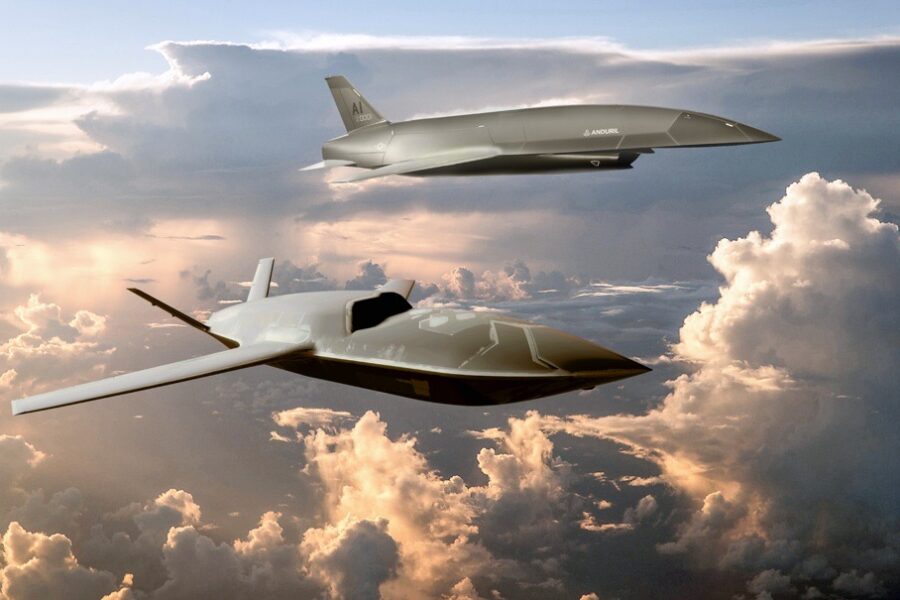
The U.S. Air Force announced on August 13, 2026, that it had recently completed initial prototype evaluations for a system called the Collaborative Combat Aircraft (CCA) Portable Command and Control Enclave, or C2E — a compact ground station built to command and control semi-autonomous aircraft from locations far removed from established air bases★.
The evaluations, which the Air Force Life Cycle Management Center (AFLCMC) described as a key milestone, assessed both the physical mobility of industry partner hardware and the software agility of the systems in conditions meant to simulate resource-constrained, austere environments★. Demonstrations were conducted at Springfield Air National Guard Base in Ohio, hosted by the 178th Wing of the Ohio Air National Guard.
What CCAs Are and Why Ground Infrastructure Matters
For that model to function outside of well-resourced main operating bases, the service needs ground control infrastructure that can move with the fight. Portable enclaves address that problem by allowing operators to stand up CCA command nodes quickly at forward or dispersed locations. AFLCMC characterized the C2E effort as central to how the service intends to manage semi-autonomous aircraft in actual field conditions, not just in test environments★.
First Prototype Phase Complete
The August evaluations mark the conclusion of the first prototype phase, meaning industry partners have now demonstrated their systems meet baseline mobility and software performance thresholds in a structured test setting★. The next steps — further refinement, additional testing phases, and eventual fielding timelines — were not detailed in the official announcement, but the completion of this round positions the program to move toward more operationally realistic trials★.
The portable C2E fits into a broader Air Force effort to make advanced autonomous systems operable from distributed, survivable positions rather than centralized hubs★. How satellite communications will be integrated into the enclave's architecture to maintain connectivity during distributed operations was not addressed in the available official materials, though the portability requirement strongly implies the need for beyond-line-of-sight data links in any operational deployment★.
★ AI inference: One or more analytical conclusions in this article were drawn by the AI from cited facts and are not directly stated in the cited sources.