
The U.S. military is moving on several fronts simultaneously this week to deepen its long-range strike capacity and sharpen its space-based intelligence picture ahead of any potential high-intensity conflict in the Indo-Pacific.
Stocking Up on Precision Munitions
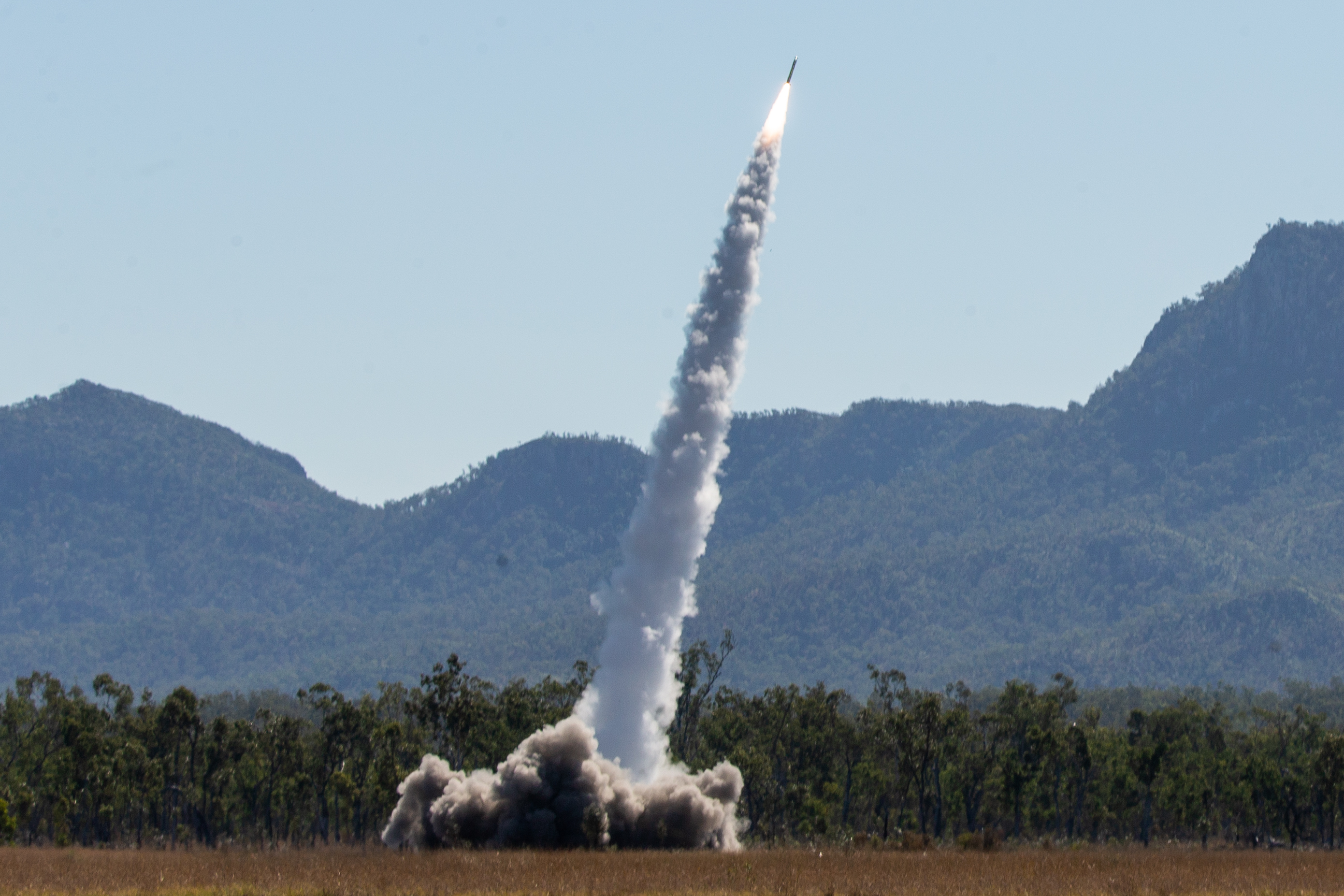
The Army issued a request this week for the manufacture of 133,014 Guided Multiple Launch Rocket System (GMLRS) rockets to be delivered by 2034 — a volume that underscores how seriously planners are treating sustained-fire requirements in a protracted conflict scenario.
Separately, Raytheon has secured a $23 billion contract to expand production of the Tomahawk cruise missile★. Together, the GMLRS request and the Tomahawk deal represent a significant acceleration in the accumulation of standoff and precision-strike weapons suited to the ranges and operational geometry of the Pacific.
Eyes in Space
The munitions buildup is paired with a push to improve the intelligence infrastructure needed to identify and track targets. The National Reconnaissance Office is expanding its contract with HawkEye 360, a commercial satellite operator whose constellation detects radio-frequency emissions from radars, ships, and other electronic emitters★. Broader NRO access to that data would improve the U.S. government's ability to locate and monitor mobile or maritime targets — precisely the kind of threat picture that matters in a contested Indo-Pacific environment.
On the orbital surveillance side, Japan launched a second U.S. military payload aboard the Quasi-Zenith Satellite 7 (QZS-7). The hosted payload is designed to monitor activity in space above the Indo-Pacific region, and its data will flow into U.S. Space Surveillance operations alongside feeds from the first payload carried on the predecessor satellite QZS-6.
Taken together, the moves — long-range strike munitions in greater volume, cruise missile industrial capacity, commercial RF intelligence from orbit, and allied satellite hosting for space surveillance — reflect a layered approach to ensuring that U.S. forces can both find targets and strike them repeatedly over an extended campaign, without running short of either information or weapons.
★ AI inference: One or more analytical conclusions in this article were drawn by the AI from cited facts and are not directly stated in the cited sources.