
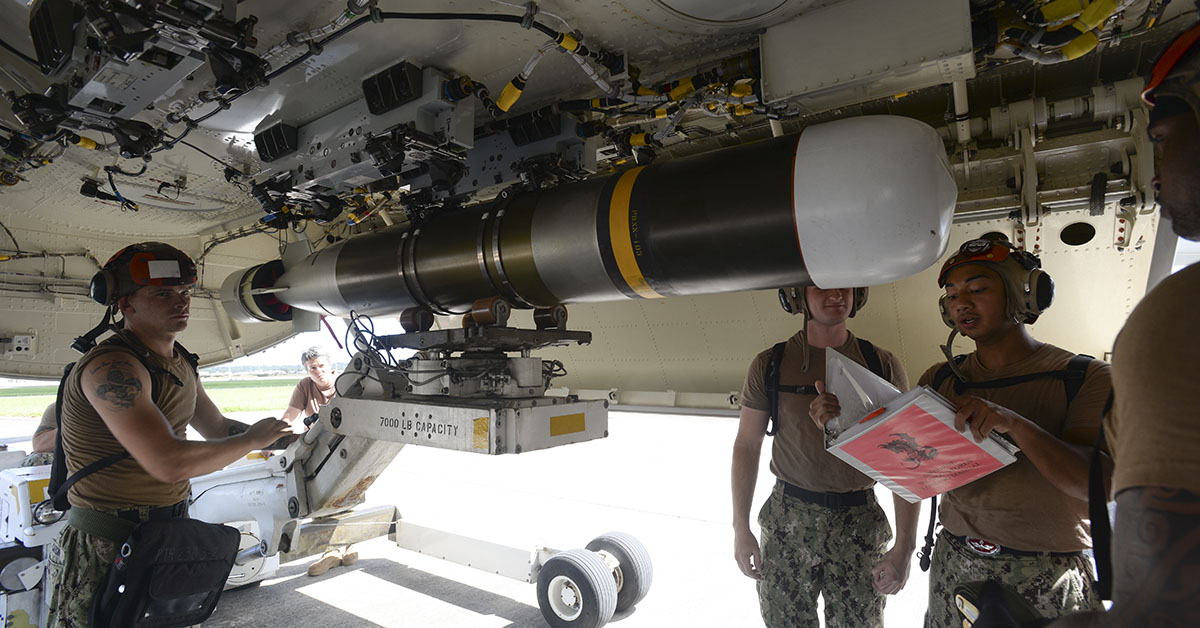
The U.S. military used its 2026 summer naval exercises to demonstrate two distinct but complementary advances in asymmetric sea-denial: a proven capability pairing the B-2 stealth bomber with the Long-Range Anti-Ship Missile (LRASM), and a newly announced program to develop an air-launched torpedo built around glide-weapon technology.
B-2 and LRASM: Stealth Meets Ship-Killing
The Air Force had disclosed in late June 2026 that the B-2 Spirit could carry and launch the LRASM — a precision-guided, low-observable anti-ship cruise missile — a pairing described as particularly potent given the bomber's ability to penetrate contested airspace across vast ocean expanses like the Pacific. The summer exercises converted that announcement into live-fire validation: a B-2 employed the missile against a decommissioned target vessel, according to Breaking Defense. The combination allows U.S. forces to threaten adversary surface fleets from standoff ranges and altitudes that reduce exposure to enemy air defenses★, advancing a doctrine centered on denying rival navies sea control without requiring close engagement★.
Silent Anvil: Hunting Submarines from the Air
Running in parallel, the Navy on August 25 revealed plans for the Silent Anvil Air-Launched Torpedo, or SAA-LT — a new weapon designed to engage enemy submarines from aircraft using a glide-weapon architecture. Aviation Week reported that the Navy's preferred design would roughly match the dimensions of Boeing's 250-lb.-class GBU-39 Small Diameter Bomb, suggesting an emphasis on compact form factor and potential for carriage aboard a range of aircraft★. Defense News and Military Times both confirmed that the Navy is soliciting contractors to explore two distinct design approaches for the system, leaving the final configuration open while the service assesses what configuration best fits operational needs★.
Together, the two programs illustrate a deliberate push toward longer-range, lower-signature weapons that can be employed from aircraft — shifting the burden of risk away from surface ships and submarines in high-threat environments. The B-2/LRASM pairing addresses the surface threat; the SAA-LT addresses the undersea one. Both rely on stealth or standoff to complicate an adversary's ability to detect, track, and counter the launch platform before a strike is complete. The simultaneous maturation of these capabilities, one entering live-fire validation and the other entering the contractor solicitation phase, signals that the Pentagon is treating next-generation naval strike not as a future program of record but as an active operational priority★.
★ AI inference: One or more analytical conclusions in this article were drawn by the AI from cited facts and are not directly stated in the cited sources.