
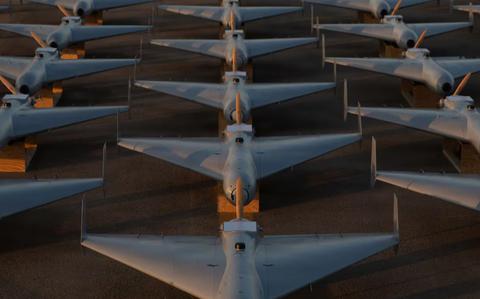
U.S. Central Command has formally launched Task Force Falcon Strike, a multinational attack-drone unit built around one-way unmanned systems operating across air, surface, and undersea domains. The force is managed jointly by U.S. military personnel and regional partners, and CENTCOM commander Adm. Brad Cooper framed it explicitly as an expansion of a previous initiative. "Task Force Falcon Strike will expand on Scorpion Strike's success given the tremendous innovation happening among our regional allies and partners," Cooper said in a statement. The launch, announced in mid-August, reflects a deliberate command-wide push to integrate partner-nation drone capabilities into a coherent offensive structure rather than treating them as supplementary assets.
The Falcon Strike announcement arrived alongside separate reporting that Qatar is receiving tanker aircraft support as part of what has been described as a broader regional arrangement, and that CENTCOM is building out its drone force presence across the theater. The layering of these commitments underscores how heavily the command is leaning on Gulf partners as both basing hosts and operational contributors.
Directed Energy at the Border, Vulnerability in Bahrain
On the homeland side of the ledger, the military has put directed-energy counter-drone systems to operational use. An AV directed-energy system was deployed and used to defeat unmanned aircraft at the southern border, according to Breaking Defense.★ The episode is notable as a real-world data point for directed-energy performance outside of test conditions.
While counter-drone technology is moving forward, a Defense News opinion piece published in late August raised pointed concerns about the condition of Naval Support Activity Bahrain following what the author describes as an attack that left the installation below pre-attack capability. The piece argues that if NSA Bahrain is not restored to its prior operational state, it will fundamentally alter how the U.S. Navy conducts operations in the region. Because the Defense News piece is an opinion submission rather than a reported news story, the severity of the damage and the timeline for recovery should be treated as the author's analytical assessment rather than confirmed official figures — though the underlying concern about infrastructure resilience aligns with broader reporting on regional basing risk.
Congress Returns to a Crowded Defense Inbox
Layered over all of this is a significant legislative moment. When Congress reconvenes in September, defense spending will be among the most consequential items on the calendar, with Middle East operations and associated partner commitments — including the Qatar tanker arrangement — among the priorities competing for funding and political attention. Breaking Defense reported that the House and Senate face a substantial backlog of defense business, and the outcome of those deliberations will have direct downstream effects on CENTCOM's ability to sustain and expand the capabilities it is currently standing up. The convergence of a new drone task force, partner-nation support agreements, a compromised naval installation, and an uncertain appropriations cycle makes the coming weeks an unusually consequential window for U.S. military posture across the region.
★ AI inference: One or more analytical conclusions in this article were drawn by the AI from cited facts and are not directly stated in the cited sources.