
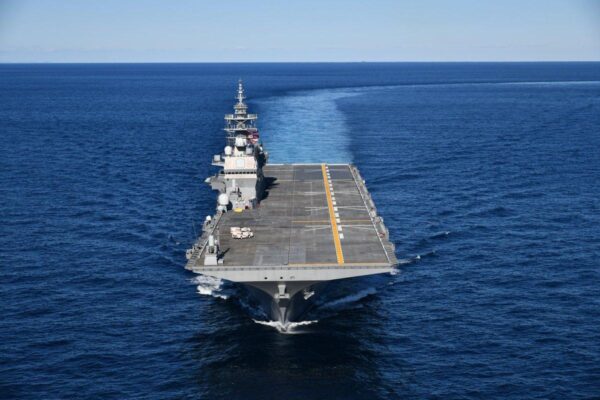
Japan and South Korea are pushing ahead with significant naval expansion programs, each responding to a Chinese military buildup that regional analysts and official defense documents now characterize as fundamentally altering the Indo-Pacific security landscape.
Japan's 2026 Defense White Paper, released in August, provided one of the clearest official articulations of the threat driving these investments. The document highlighted China's accelerating integration of blue-water naval forces, including the first confirmed deployment of a Jiangkai III-class frigate operating as part of a People's Liberation Army Navy carrier strike group in the Pacific. That milestone underscored how quickly the PLAN has matured from a coastal and near-seas force into one capable of sustained deep-ocean operations★ — a development that Tokyo and Seoul are openly citing as justification for their own modernization programs★.
Building Harder-Hitting Fleets
A concrete example came in late September 2025, when the Japan Maritime Self-Defense Force's JS Chokai, a Kongo-class Aegis destroyer, departed Yokosuka Naval Base bound for San Diego. Their decisions to invest in longer-range weapons, improved missile defense architecture, and more capable surface combatants★ carry real weight for the regional balance.
What makes this moment notable is less any single program than the convergence of political will and procurement timelines. Both governments appear to have concluded that the window for deliberate, long-term modernization is narrowing as China's naval integration accelerates★ — and are funding their fleets accordingly.
★ AI inference: One or more analytical conclusions in this article were drawn by the AI from cited facts and are not directly stated in the cited sources.