
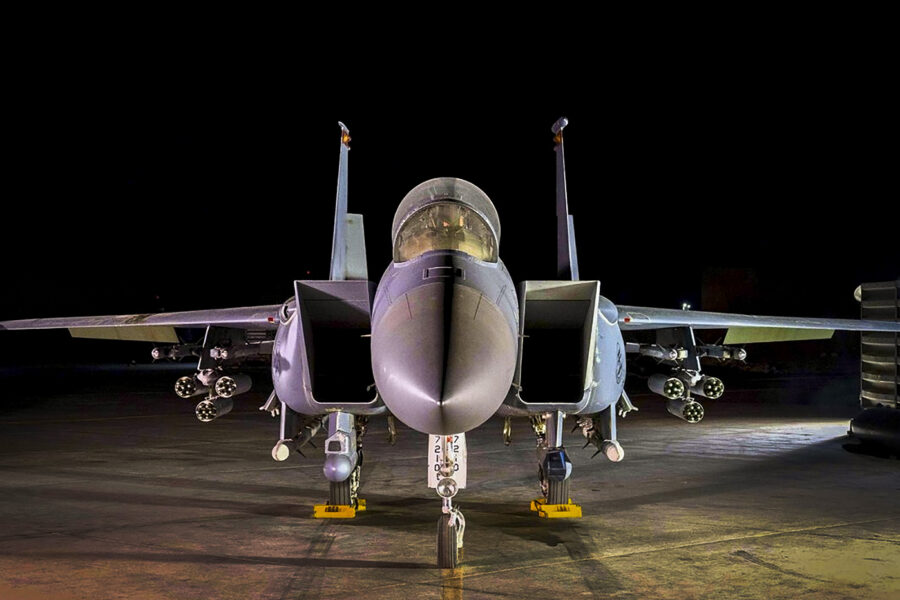
A Fast Fix for a Growing Threat
With Iranian-made drones posing an escalating threat across the Middle East in 2025, the U.S. Air Force moved quickly to give its F-15E Strike Eagles a dedicated counter-drone weapon — completing the integration in roughly nine days. The munition selected was the AGR-20F Advanced Precision Kill Weapon System II, or APKWS II, a laser-guided 70mm rocket designed to be both precise and inexpensive compared to the air-to-air missiles typically carried by fast jets★. The speed of the fielding underscored a deliberate shift away from slow-moving procurement timelines in favor of urgent operational adaptation.
The choice of APKWS II reflects a cost-exchange logic that has become central to counter-drone strategy: rather than expending high-value missiles on relatively cheap enemy unmanned aircraft, the Air Force opted for a weapon system that keeps engagement costs low without sacrificing accuracy★. The rocket's laser guidance makes it well-suited to the task of tracking and destroying small, low-speed drones that can otherwise prove elusive for systems engineered to engage faster, more complex targets★.
From Emergency Fix to Standard Capability
What began as a rapid, improvisational response has since become the Air Force's primary air-to-air tool against drone threats in the theater. According to The War Zone, laser-guided APKWS II rockets are now the principal anti-drone weapon for U.S. Air Force jets operating in the Middle East — a transition from emergency stopgap to established practice that happened within months of the initial integration★.
Air & Space Forces Magazine, reporting in September 2026, noted that the original fielding had occurred the previous year under significant time pressure as Iranian unmanned aerial threats multiplied. The compressed timeline — getting a new weapon system onto a frontline aircraft and into operational use in under two weeks — reflects both the urgency commanders felt and the institutional flexibility the service was able to marshal when the situation demanded it.
The episode illustrates a recurring tension in modern military aviation: procurement cycles that span years can leave gaps when threat environments shift rapidly. The APKWS II integration on F-15Es shows one model for bridging that gap, leveraging an existing, proven munition and adapting it quickly to a new mission set rather than waiting for a purpose-built solution. Whether the approach can scale to other emerging threats remains an open question, but in this instance the Air Force demonstrated that operational necessity can compress timelines that ordinarily resist compression.
★ AI inference: One or more analytical conclusions in this article were drawn by the AI from cited facts and are not directly stated in the cited sources.