
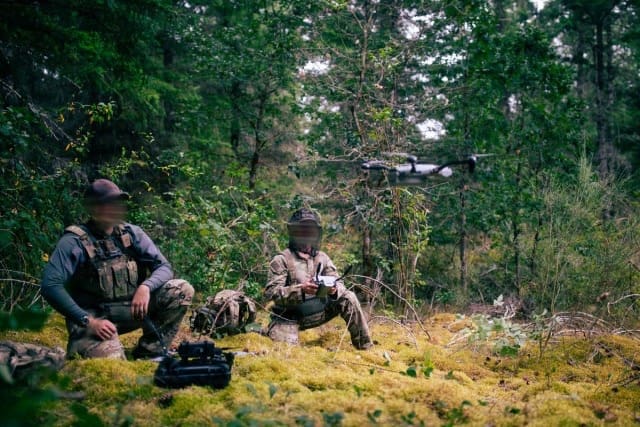
Special Forces Embrace Drones as Primary ISR Tools
Green Berets assigned to the 1st Special Forces Group (Airborne) conducted dedicated drone intelligence, surveillance, and reconnaissance training at Joint Base Lewis-McChord, Washington, on August 11, 2026. The exercise centered on establishing the ground communication infrastructure required to operate drones specifically as ISR assets — a deliberate departure from treating unmanned systems as secondary or supplementary tools. The training signals that drone platforms are now being fielded and exercised as primary collection nodes within special operations intelligence workflows.
Separately, later in August, 1st SFG(A) earned top honors at the first-ever 1st Special Forces Command (Airborne) Best Drone Team Competition, held August 24–28 at Fort McClellan and Clarke Range Complex in Alabama. The inaugural competition underscored how seriously the Army is treating drone proficiency as a core special operations competency, institutionalizing it through formal evaluation rather than leaving it to ad hoc unit-level experimentation.
A Broader Shift Toward Multi-Domain ISR Integration
Both events reflect a larger modernization trajectory the U.S. military is pursuing: integrating drone platforms, satellite capabilities, and common command-and-control systems into a unified ISR framework, as reported by Breaking Defense in September 2026. Rather than operating these collection layers in parallel silos, the emerging approach seeks to fuse airborne and space-based sensors under standardized protocols★, enabling commanders and distributed units to draw on a coherent, real-time intelligence picture regardless of which platform generated the data★.
For special operations forces — which routinely operate in small, dispersed teams far from traditional support infrastructure — this kind of integrated architecture carries obvious operational value. The ability to task a drone, pull satellite imagery, and share processed intelligence through a common control system without manually reconciling data from incompatible networks could meaningfully compress the time between collection and action★. However, that same integration introduces new demands: soldiers must maintain proficiency across multiple platforms and communication systems, and the logistics footprint for sustaining drone operations in the field adds complexity that conventional ISR pipelines have not always required.
The JBLM training and the Alabama competition together suggest the Army is not waiting for a fully mature system before building the human skills to support it. By embedding drone ISR competencies directly into special forces evaluation and training cycles★, the service is effectively making the workforce transformation concurrent with the technology development — a deliberate, if demanding, approach to modernization.
★ AI inference: One or more analytical conclusions in this article were drawn by the AI from cited facts and are not directly stated in the cited sources.