
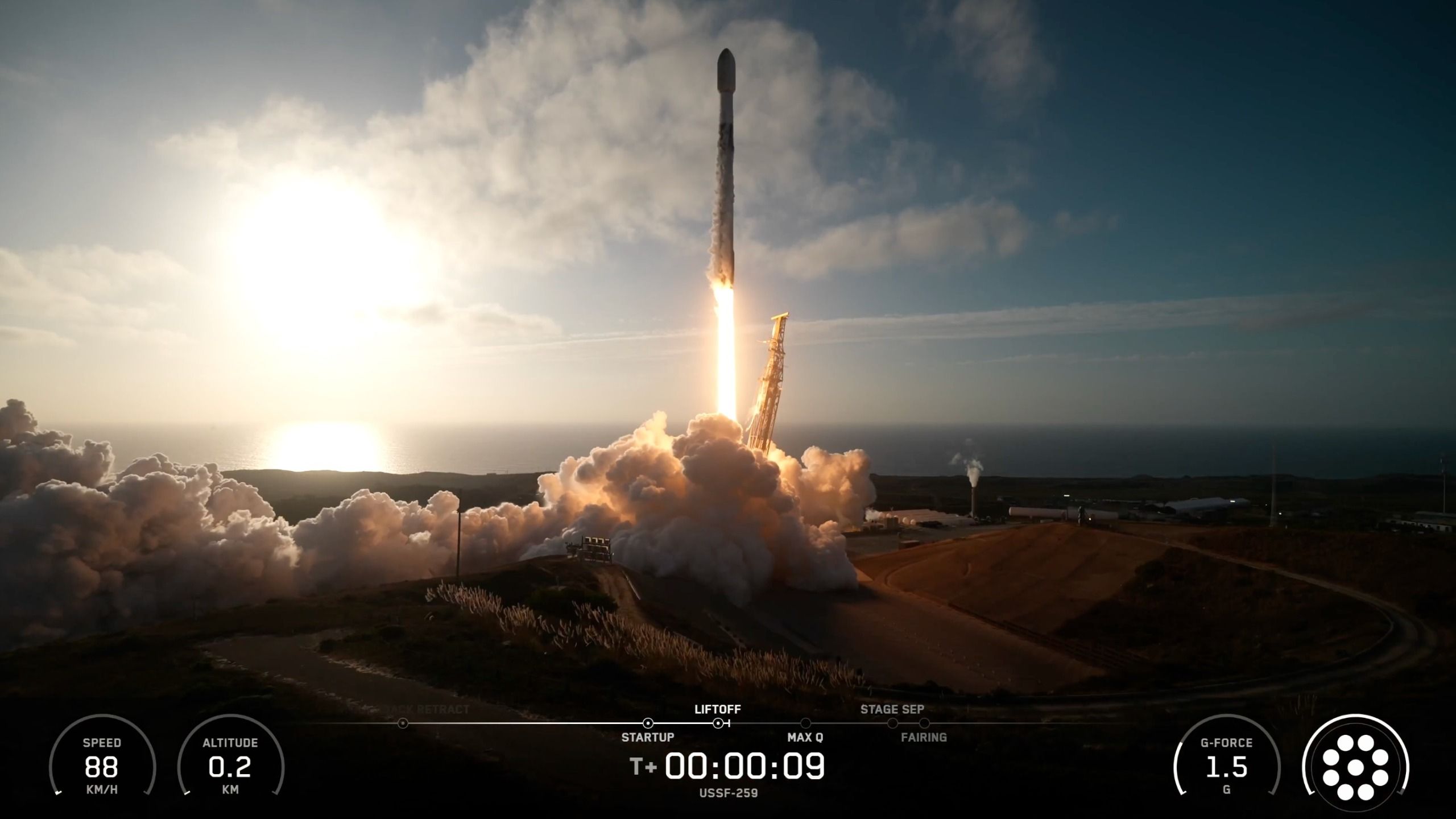
Within the span of four days, SpaceX used a single launch complex at Vandenberg Space Force Base to support both a classified national security mission and a routine commercial satellite deployment — a compressed sequence that puts in sharp relief how thoroughly military and commercial space priorities now share the same infrastructure.
Two Launches, One Pad
The first mission, designated USSF-259, lifted off from Space Launch Complex 4 East on September 16, 2026, at 6:07:56 p.m. PDT. A Falcon 9 carried an unspecified number of satellites to orbit on behalf of the U.S. Space Force, with payload details remaining classified. The launch was notable in another respect: according to Space.com, it was itself the second classified Space Force mission SpaceX had flown in less than a week, underscoring an already rapid operational tempo before the Starlink flight even took place.
Three days later, on September 19, 2026, another Falcon 9 rose from the same pad 4E at 6:47 p.m. PDT, this time deploying 27 Starlink V2 Mini satellites into orbit. Spaceflight Now reported it as the 81st Starlink mission of the year — a figure that, by itself, conveys the industrial scale at which SpaceX is now building out its broadband constellation.
Shared Infrastructure, Dual Purposes
What makes the pairing significant is not any single launch but the pattern they reveal. The same Falcon 9 platform, the same concrete pad, and much of the same ground infrastructure serve both the Pentagon's classified constellation requirements and SpaceX's commercial satellite internet ambitions★.
The classified nature of USSF-259 means the specific satellites aboard, their orbit, and their intended mission remain undisclosed. What is confirmed — by both Spaceflight Now and Vandenberg's own official release — is the mission designation, the launch site, and the time. Beyond that, the payload is opaque by design.
That opacity sits in deliberate contrast to the Starlink mission, which SpaceX announced, livestreamed, and logged publicly as mission 81 for the year★. The juxtaposition is its own kind of transparency: the same company, the same rocket, one fully public and one entirely secret, flying from the same strip of California coastline days apart. As the pace of both programs continues to accelerate, the question of how commercial satcom capacity and military connectivity requirements intersect — and who sets the terms of that relationship — is one that neither SpaceX nor the Space Force has fully answered in public.
★ AI inference: One or more analytical conclusions in this article were drawn by the AI from cited facts and are not directly stated in the cited sources.