
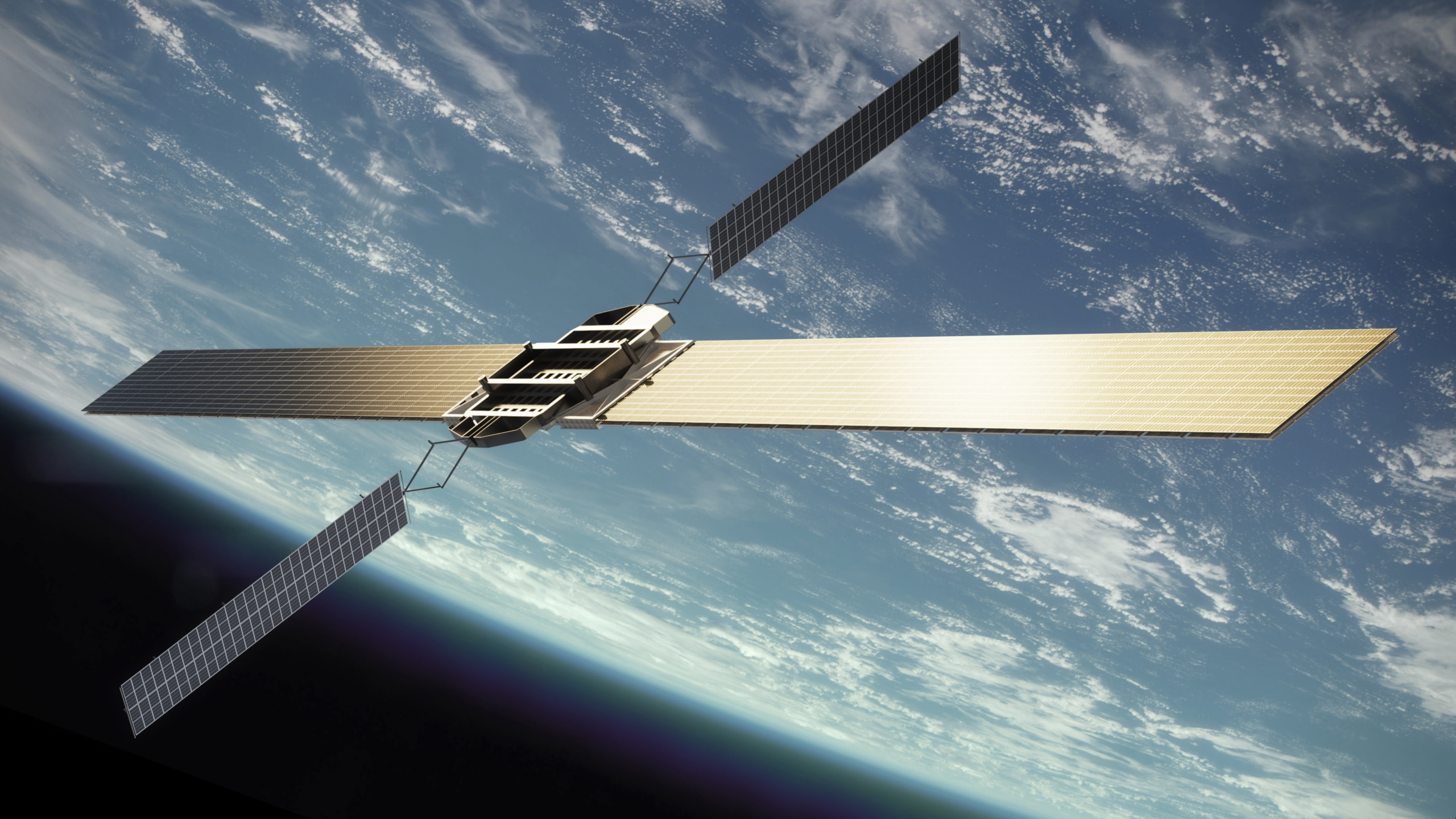
Three commercial space companies announced funding rounds within approximately 96 hours in late June 2026★, collectively directing $58 million into segments of the LEO economy that are still building their operational foundations: controlled satellite reentry, edge computing on orbit, and intelligent data extraction from satellite platforms. The compressed timing is likely coincidental, but the alignment of focus areas is not — all three companies are betting that the next phase of the LEO market rewards capability layers built on top of connectivity infrastructure, not just connectivity itself.
ElevationSpace Closes $40M Series B for Commercial Reentry
The largest of the three rounds belongs to ElevationSpace, a Japanese startup developing a commercial reentry vehicle. The company announced the $40 million Series B on June 19, bringing its total raise to $63.5 million across a 90-person team.
Commercial controlled reentry is one of the narrower niches in the new space economy, but it is a genuinely enabling capability. Satellites or experiment carriers that can return materials — biological samples, manufactured products, or data storage media — from orbit to the ground open up a category of in-space services that today require either government mission support or purpose-built spacecraft. ElevationSpace is targeting the commercial demand for this service, expected to grow as microgravity manufacturing, life science research, and in-space logistics gain commercial traction.
For satcom-adjacent operators, the reentry angle matters primarily as infrastructure. A commercially available, repeatable reentry service de-risks in-orbit experiments and enables satellite bus suppliers and payload developers to plan retrieval as part of standard mission architecture rather than treating it as a one-off engineering problem. The $40 million round gives ElevationSpace the financial depth to work through regulatory coordination, hardware qualification, and mission planning required before commercial operations can begin — none of which is fast or inexpensive. Building a reentry vehicle to the reliability standards needed for recurring commercial service, including coordinating reentry corridors, recovery logistics, and customer payload interfaces, demands substantially more than prototype engineering. The Series B appears positioned to carry the company through those milestones and toward a first demonstration.
Orbital Edge Computing and Satellite AI Draw a Combined $18M
Sophia Space, an orbital-compute startup, disclosed a $7 million funding round alongside an agreement with Apex Space to conduct a demonstration flight in 2027. Sophia Space is developing edge computing hardware designed to be deployed in orbit, processing data onboard rather than downlinking it raw for ground-based analysis★. The Apex partnership is a meaningful program milestone: selecting a spacecraft provider and committing to a specific demonstration year moves the company from development roadmapping into actual mission planning.
For the satcom sector, on-orbit edge computing changes the economics and architecture of satellite data missions. Raw data downlink consumes expensive bandwidth and introduces latency that is unacceptable for time-critical applications. Processing data before transmission — filtering, compressing, or inferring from it aboard the spacecraft — reduces the bandwidth burden and enables near-real-time decision-making at the edge. Sophia Space's 2027 demo flight will serve as the primary validation event for its hardware and, if successful, provide the flight heritage essential for customer acquisition and any subsequent capital raise. The $7 million round is appropriately sized for the pre-demonstration phase: it is runway to reach a flight, not scale capital, which makes the Apex agreement central to the investment thesis.
Ubotica, a Dublin-based space AI company, raised $11 million on the same day to accelerate commercialization of its satellite AI platform. Onboard AI inference enables faster, more persistent maritime domain awareness and reduces ground-segment data processing requirements.
The $11 million round is explicitly aimed at commercialization rather than research and development★, a distinction that signals Ubotica has a working technical platform and is now focused on customer acquisition, operational scalability, and the sales infrastructure needed to generate recurring revenue. The size of that addressable market gives Ubotica a realistic path to sustainable revenue, provided execution holds.
Sophia Space and Ubotica occupy adjacent but distinct positions in the value chain. Sophia Space is building general-purpose compute infrastructure that any satellite application could eventually run on; Ubotica has built a specific application — maritime intelligence — on satellite AI platforms. Both companies reflect the same underlying thesis: that the value of a satellite constellation depends increasingly on what it processes, not just what it observes or transmits.
LEO Capacity Expansion Provides Demand Backdrop
These funding rounds are arriving as LEO communications infrastructure is scaling rapidly. On July 5, 2026, China Aerospace Science and Technology Corporation launched 20 new satellites for the G60 constellation aboard a Long March 8A rocket from Wenchang's commercial launch complex, deploying them into polar orbit. G60 is operated by Shanghai Spacesail Technologies, and the latest deployment continues a steady build-out of the constellation's global coverage.
The G60 expansion illustrates the pace at which LEO satellite populations are growing. More satellites in orbit mean more data being generated, more bandwidth being allocated, and more operational complexity for ground systems and customers. The commercial demand that companies like Ubotica and Sophia Space are addressing — onboard processing, intelligent surveillance, efficient data pipelines — grows proportionally with the scale and capability of the constellations they serve. A constellation deploying Ku, Q, and V band payloads simultaneously is managing significant spectral diversity and data throughput, precisely the environment where edge processing and AI-assisted analysis carry compounding value.
ElevationSpace operates on a longer cycle, but the same constellation expansion dynamic eventually creates demand for its platform as well. As LEO population density increases, the logistics of end-of-life management, hardware retrieval, and in-space servicing become more commercially relevant, and reentry-capable vehicles are a natural part of that logistics layer.
Across all three companies, the capital deployed in late June 2026 is modest relative to the full cost of building satellite constellations or launch systems — but it is going into enabling capabilities that the maturing LEO economy increasingly needs. The 2027 Sophia Space demonstration with Apex is the nearest-term public milestone to watch; ElevationSpace's progress toward a first mission schedule and Ubotica's early commercial contract activity will be the indicators that determine whether June 2026's funding rounds translate into durable businesses.
★ AI inference: One or more analytical conclusions in this article were drawn by the AI from cited facts and are not directly stated in the cited sources.