
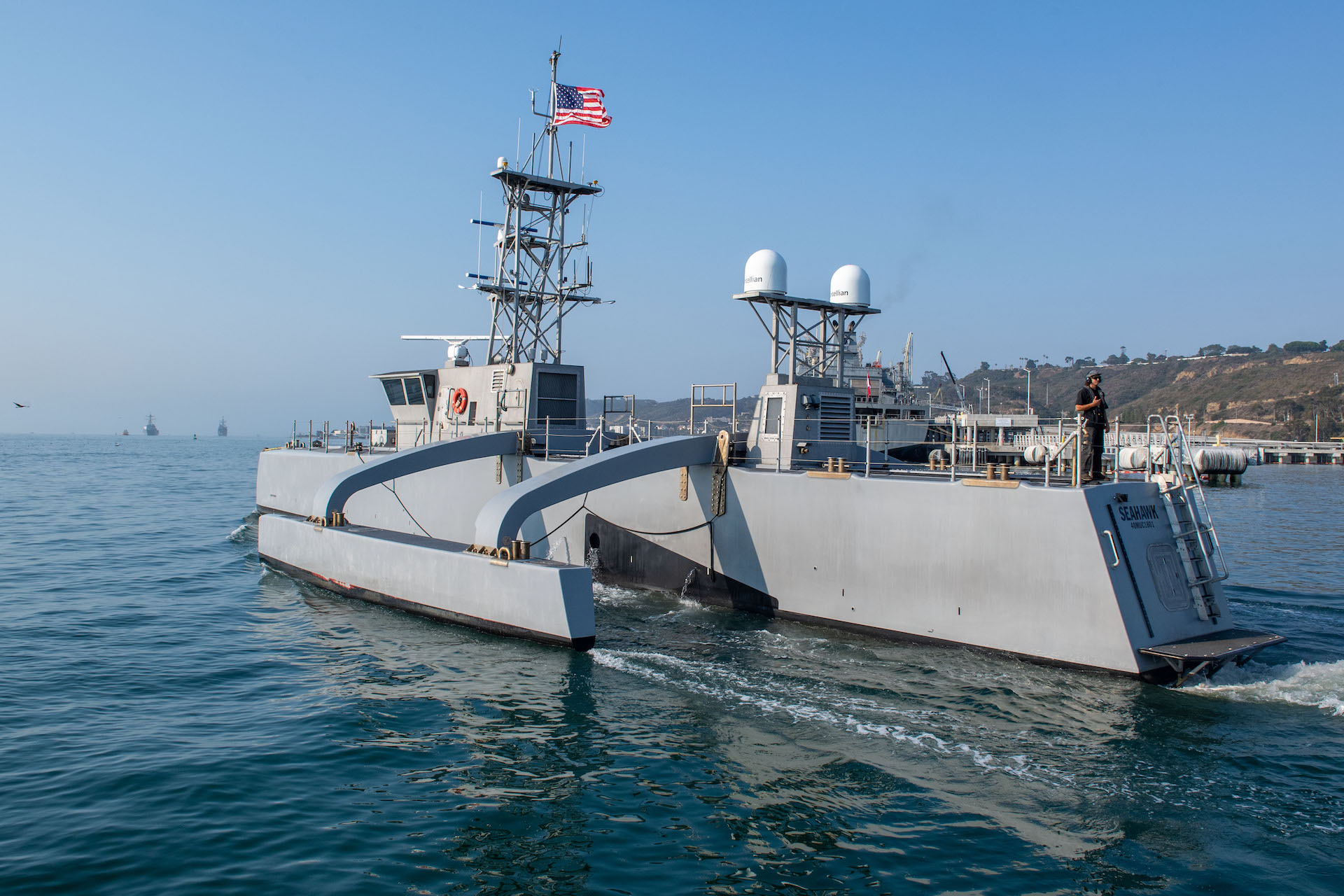
The U.S. Navy took a concrete step toward broadening its autonomous surface fleet on September 24, releasing a formal call for solutions and hosting an industry day focused on Phase II onboarding for its medium unmanned surface vessel (MUSV) marketplace. The event, organized by the Direct Reporting Program Manager for Robotic and Autonomous Systems (DRPM RAS), gave Department of the Navy officials a structured opportunity to engage with companies interested in entering the vendor pool — bringing new sea drone designs into a procurement vehicle the service has positioned as the centerpiece of its future uncrewed surface acquisition strategy★.
The September activity is the latest milestone in an acquisition model the Navy formally launched roughly six months earlier. In March 2026, following the cancellation of its predecessor MASC program, DRPM RAS stood up a competitive online marketplace designed to bring MUSV vendors into a more flexible and iterative framework than a conventional program-of-record structure allows★. The September call for solutions and accompanying industry day represent Phase II of that effort — an active expansion of the vendor base and, potentially, the range of platform designs available to meet Navy requirements.
From MASC Cancellation to Marketplace
The shift to a marketplace structure came directly out of the MASC program's termination. and updating as technology and requirements evolve. The model draws more from commercial procurement practice — where pre-qualified suppliers are maintained in a continuously accessible pool — than from the program-of-record structures that have governed most Navy shipbuilding and major naval systems acquisition.
Coverage of the March 2026 launch framed the initiative as part of a broader 'Golden Fleet era' shift in how the Navy approaches autonomous surface vessel acquisition, with the MASC termination and marketplace launch announced together to underscore that the new vehicle is a structural replacement, not a supplement to previous procurement efforts★.
Rebecca Gassler, portfolio acquisition executive for the Navy's robotic and autonomous systems programs, laid out the long-term intent at the March launch. The service aims to establish a procurement mechanism that opens on a regular and recurring basis — designed eventually to cover not just MUSVs but additional vessel classes — calibrated to absorb what officials expect to be growing demand for unmanned systems across a diverse range of missions. That framing positions the MUSV marketplace not as a one-time procurement action but as a template for how the Navy intends to source its broader autonomous maritime portfolio over time.
USNI News coverage of the March launch quoted Gassler with an additional formulation: "It's the first of what will be a recurring marketplace," she said — making explicit what the mechanism's phased structure implies and confirming that Phase II onboarding is operating as designed rather than representing an unplanned expansion. Both USNI News and Navy Times published coverage of the marketplace launch on March 26, 2026, the same day the MASC program's termination was announced★, reinforcing that the two developments were framed together as a deliberate structural shift in how the Navy sources autonomous surface vessels.
The initiative is also unfolding against a backdrop of institutional change in how the Pentagon manages unmanned systems acquisition at large. DRPM RAS is a Navy-specific organization with its own command structure and authorities★, but the SAM.gov posting for the September 24 event confirmed the organization as the issuing entity for the Phase II call for solutions, with both Department of the Navy and DRPM RAS officials on hand to brief prospective industry partners on program requirements and collaboration pathways.
Phase II Onboarding: Structure and Implications
The September 24 industry day was aimed at companies that had not enrolled during the marketplace's initial phase.★ DRPM RAS designated the event as Phase II onboarding, indicating the mechanism is now actively recruiting new entrants — both platform designs and vendors without existing marketplace agreements. The SAM.gov posting invited companies considering collaboration with DRPM RAS to engage directly with program officials, hear about MUSV requirements, and evaluate their own qualification pathways before submitting solutions.★
The SAM.gov posting extended the invitation specifically to those "interested in potential collaboration with DRPM RAS" — language that frames the industry day as an accessible entry point for companies at any stage of engagement, including those without prior Navy autonomous systems relationships. That positioning signals that the program office is seeking to broaden the qualified vendor pool beyond Phase I participants, not simply briefing incumbents on updated requirements.
The rolling enrollment model has practical consequences for the MUSV industrial base. A marketplace that reopens periodically changes that calculus: entering in Phase II or a subsequent cycle remains a viable path, not a fallback. For vendors developing or refining autonomous surface vessel capabilities, that predictability can meaningfully affect investment decisions and business development timelines.
The public record does not yet detail how many vendors were enrolled during Phase I, what the specific performance thresholds for MUSV marketplace qualification entail in full, or how delivery agreements are structured once a vendor is onboarded. The SAM.gov posting framed the relationship in collaborative terms. For vendors without established Navy autonomous systems relationships, the industry day format provides a meaningful point of entry into a procurement environment that can be difficult to navigate without direct program contact.
MUSV Capabilities and Strategic Rationale
The marketplace model fits this platform category particularly well at this stage of technology maturity. That optionality is most valuable precisely when concepts of operation are still being written.
Applying a marketplace model at greater scale and platform complexity will require the Navy to demonstrate that performance accountability and integration management can work in that environment — areas the MUSV initiative will need to address credibly before the approach extends further. The current effort is building the contractual precedent and institutional experience that any broader application would require.
Next Milestones
DefenseScoop, reporting from September 24, confirmed that the Navy's release of the call for solutions coincided with the conduct of the Phase II industry day — linking the formal procurement action to the direct industry engagement activity on the same date.
Longer term, the recurring nature of the mechanism means Phase II is not the final enrollment window. Gassler's March remarks were explicit that additional cycles are planned as demand evolves and new vessel categories are eventually brought into the model. For the autonomous maritime sector, that commitment functions as a durable commercial signal: the Navy is not treating MUSV procurement as an experimental program awaiting validation, but as a permanent and expanding operational requirement backed by procurement infrastructure designed to serve it on an ongoing basis★.
★ AI inference: One or more analytical conclusions in this article were drawn by the AI from cited facts and are not directly stated in the cited sources.