
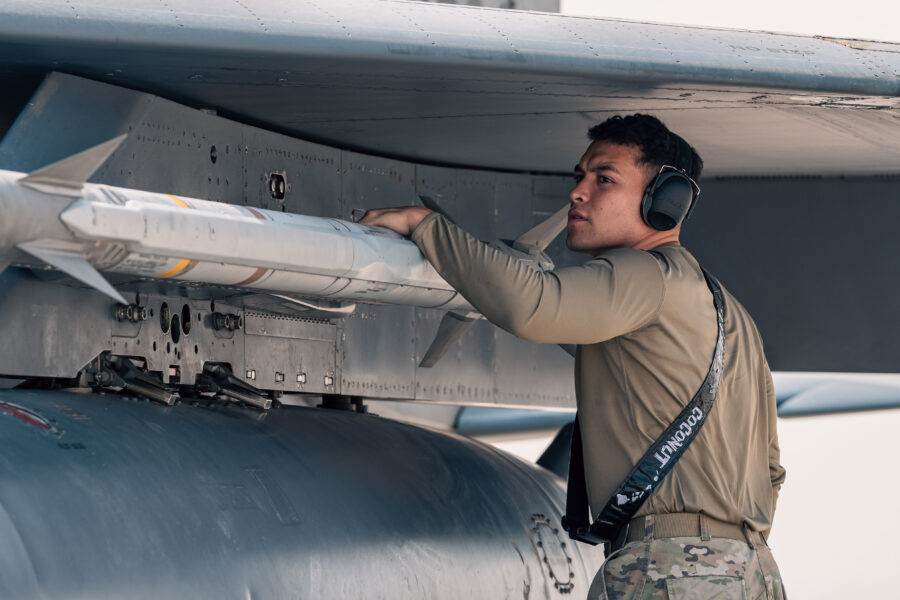
The AIM-9X Block II Sidewinder, the newest production variant of one of the U.S. Air Force and Navy's most widely fielded short-range air-to-air missiles, is failing to meet its operational availability target—a documented readiness shortfall spanning both live combat rounds and the captive air training missiles that fighter crews rely on to rehearse aerial engagement procedures. Pentagon acquisition reports, cited in September 25, 2026 coverage by Air & Space Forces Magazine, confirm the deficit continues well past a previously projected recovery date, even as manufacturer Raytheon has significantly expanded annual production rates over the past several years. The disclosure appears in Pentagon reporting that also notes the services are simultaneously accelerating inventories of the AGM-158 Joint Air-to-Surface Standoff Missile, providing a broad view of current munitions acquisition pressures across the joint force.
The Readiness Gap: Availability Data and Its Operational Weight
The AIM-9X is a fixture of the joint fighter inventory across both services. Its prevalence across the force means availability shortfalls in this system carry fleet-wide readiness implications rather than affecting a single platform or community.
A December 2023 Modernized Selected Acquisition Report (MSAR)—part of the FY 2023 Selected Acquisition Reports series—from the Office of the Under Secretary of Defense for Acquisition and Sustainment documents the shortfall with specific figures. The all-up round, meaning the live combat missile, recorded overall availability of 90 percent, broken down as 95 percent for the Navy and 86 percent for the Air Force. The MSAR attributed the gap in part to supplier base shortages and projected recovery for both the CATM and all-up round by June 2025.
That timeline has evidently not held. Air & Space Forces Magazine's September 2026 reporting draws on recent Pentagon documents to characterize the AIM-9X Block II as still falling short of its key readiness metric—indicating that the supply chain and sustainment challenges identified nearly three years ago remain unresolved beyond the window that program managers originally anticipated★.
The training missile figures carry particular operational significance. Availability in the mid-70 percent range means a substantial share of those assets is unavailable at any given time, constraining the quality and frequency of realistic air combat training at the squadron level. For the live all-up round, an 86 percent USAF availability rate implies that roughly one in seven combat missiles is out of service at any given moment★—a figure that compounds across a geographically distributed fleet and could matter significantly in scenarios requiring sustained air superiority operations. The Navy's 95 percent all-up round figure is comparatively healthier, but its CATM availability of 74 percent reflects a similar training-asset pressure as the Air Force faces. The nine-percentage-point gap between the Navy's 95 percent and the Air Force's 86 percent all-up round availability, both drawn from the December 2023 MSAR, indicates that the two services are not experiencing the combat-missile shortfall equally.
Production Ramp and Supply Chain Dynamics
Raytheon has responded with a substantial expansion of its production line. FlightGlobal's June 2025 reporting documented the company raising its AIM-9X annual production rate to 2,500 missiles, up from approximately 1,400 units in 2022. A 2024 Pentagon report cited in that coverage showed an intermediate production figure of roughly 1,644 missiles annually as of September 2024, capturing the ramp's trajectory before Raytheon reached its higher throughput target. The progression from 1,400 to 1,644 to 2,500 units annually represents a near-doubling of output in approximately three years★—a meaningful industrial effort by any standard in the precision munitions sector.
Parsing those figures in sequence, the step from 1,644 missiles per year as of September 2024 to the 2,500-unit annual rate that FlightGlobal reported on June 5, 2025 represents an increase of more than 850 units annually achieved in approximately nine months★—indicating the ramp continued to accelerate even after the 2024 Pentagon report's already-elevated baseline. Taken together with the earlier gain from the 2022 baseline of roughly 1,400 units, the progression reflects a sustained, multi-year expansion of throughput across Raytheon's manufacturing operations.
That ramp nonetheless illustrates the structural difficulty of accelerating precision munitions production on compressed timelines. The MSAR's attribution of the shortfall partly to supplier base shortages points upstream of Raytheon's final assembly operations, suggesting that production rate increases address output volume but may not fully resolve the underlying supply chain concentration that contributed to the gap in the first place. A production ramp and a sustainment-availability recovery are related but distinct challenges: building new missiles faster does not automatically repair or replace the existing inventory items experiencing availability problems.
The AIM-9X availability picture is consistent with that broader pattern: a defense industrial base that has accelerated output on several fronts simultaneously is still working to close fielded-readiness gaps. Whether Raytheon's 2,500-unit annual production rate ultimately restores both CATM and all-up round availability to program targets—and on what schedule—will likely emerge as a key indicator in forthcoming acquisition documentation.
JASSM Ramp and the Simultaneous Acquisition Picture
The same Pentagon reporting cited by Air & Space Forces Magazine also documents the services accelerating their inventories of the AGM-158 Joint Air-to-Surface Standoff Missile, which Air & Space Forces Magazine characterizes as a "vital air-to-ground missile" in its September 25, 2026 coverage.
The two programs address fundamentally different operational functions—JASSM is a standoff air-to-ground weapon★, while the AIM-9X is a short-range air-to-air system★—but their concurrent prominence in Pentagon acquisition reporting reflects the scope of the munitions investment the services are managing across mission areas at the same time. For acquisition professionals tracking program health across the joint force, the appearance of AIM-9X availability shortfalls and JASSM stockpile growth within the same reporting cycle offers a useful signal about where readiness gaps and deliberate investments are concentrated at this point in the procurement cycle.
The Air & Space Forces reporting does not provide JASSM readiness metrics comparable to the specific availability percentages documented for the AIM-9X in the MSAR★, leaving the JASSM program's current operational posture less precisely characterized in publicly available sources. The magazine's September 25, 2026 article attributes the JASSM stockpile figures to "recent Pentagon reports" without specifying which particular documents quantify the extent of the inventory buildup. The AIM-9X case, by contrast, offers an unusually concrete look at how a foundational close-range air combat weapon is performing against its own program benchmarks—and how far the gap between projected and actual recovery can extend when supplier base constraints prove more durable than anticipated. The key near-term milestone to watch is whether updated Pentagon acquisition reports revise the availability recovery timeline, identify specific subcomponent shortfalls driving the persistence of the gap, or indicate whether the production ramp to 2,500 units annually is beginning to translate into improved availability metrics at the fleet level.
★ AI inference: One or more analytical conclusions in this article were drawn by the AI from cited facts and are not directly stated in the cited sources.