
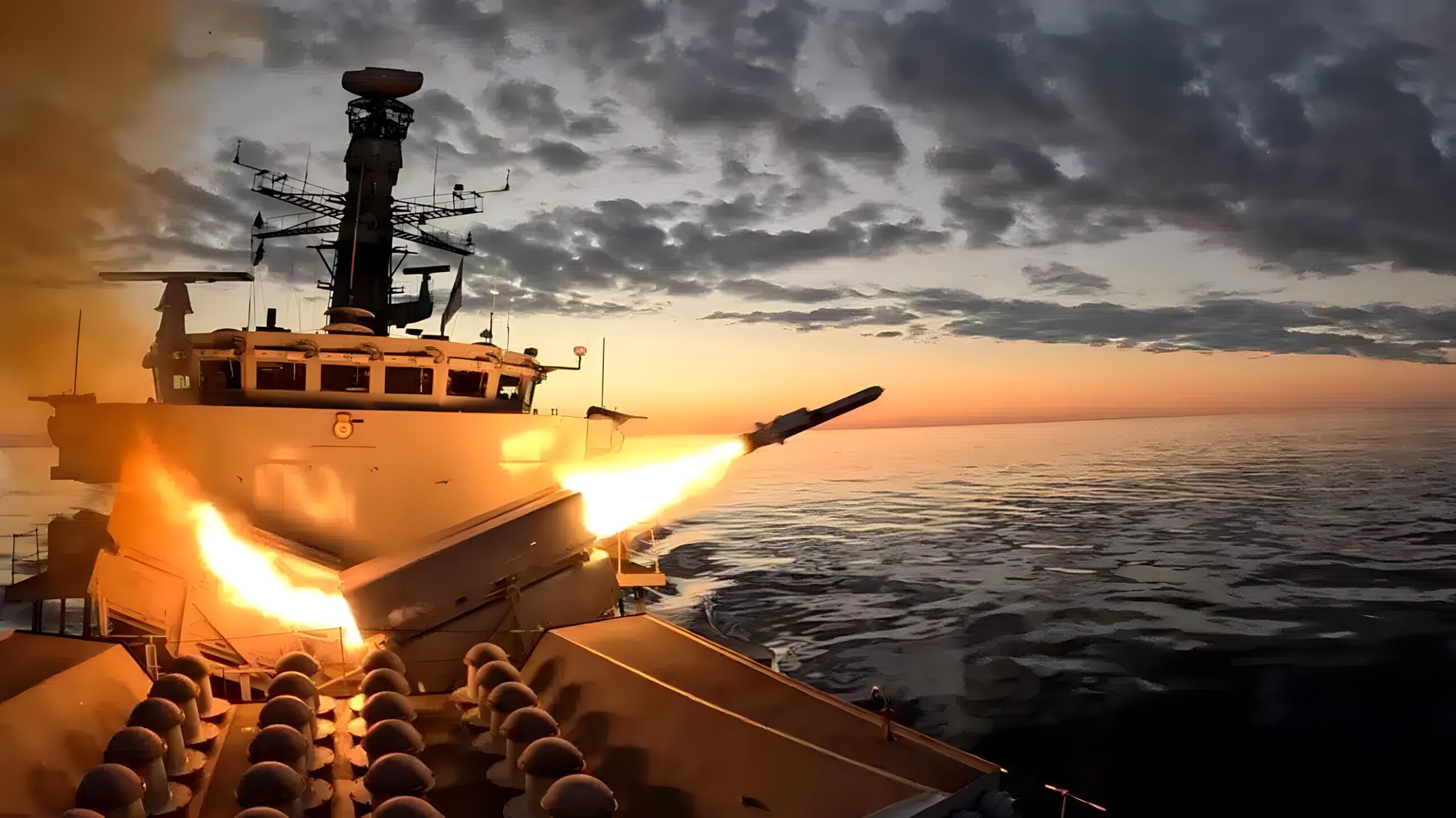
On September 28, 2026, the US Navy and Royal Navy conducted a joint sinking exercise (SINKEX) off Scotland's Hebrides, striking the decommissioned American frigate USS Klakring with at least five distinct weapon systems before a final submarine-launched torpedo confirmed the vessel's sinking★. The coordinated, multi-domain live-fire event validated a range of anti-ship, air-defense, and anti-submarine munitions★ in a single realistic scenario, combining US and Royal Navy surface, rotary-wing, and subsurface capabilities in one integrated engagement.
Navy Lookout characterized the event as the Royal Navy "proving" both Sea Venom and the Naval Strike Missile in a live-fire exercise alongside the US Navy — framing that positions both weapons as clearing a formal operational validation threshold rather than advancing incrementally through developmental test programs. The UK Defence Journal, covering the same exercise, specified that a British warship struck the frigate with a "live Naval Strike Missile," with the "live" qualifier distinguishing the firing from captive-carry or inert developmental rounds and placing it firmly in operational employment mode against a warship-class target.
The bilateral format here substantially raised the complexity bar. That coordination challenge — rather than the performance of any single weapon — is arguably the most demanding test the exercise imposed on both sides.
Weapons Employed and Strike Sequence
The final blow to the USS Klakring was delivered by an Mk 48 Advanced Capability (ADCAP) torpedo, according to a US Navy official cited by Breaking Defense. Using the torpedo as the terminal kill weapon after multiple missile strikes reflects deliberate anti-surface warfare doctrine. Sequencing the torpedo as the final weapon in a multi-missile strike chain also validates the command-and-control handoffs required to coordinate subsurface and surface fires together in a joint environment, a non-trivial procedural requirement under realistic at-sea conditions.
Navy Lookout placed the total munition count at no fewer than five distinct types across the full engagement. Breaking Defense confirmed the SM-6 was among the weapons tested. Operating the SM-6 in that anti-surface role in a joint live-fire event, rather than a controlled developmental trial, moves the capability along the maturity curve from developmental validation toward fleet employment and generates the joint procedures experience that individual service tests do not provide.
On the Royal Navy side, both Sea Venom and the Naval Strike Missile (NSM) were employed. The UK Defence Journal confirmed that the Royal Navy used both of its newest anti-ship missiles in a single event. Navy Lookout reported a specific capability milestone: a Royal Navy Wildcat helicopter fired Sea Venom at a warship target for the first time. The distinction between firing at a conventional range target and engaging an actual warship hull — with its realistic structural geometry, radar cross-section, and thermal signature — carries meaningful operational weight. Achieving that first warship live-fire milestone inside a joint exercise, rather than a standalone national trial, indicates the program had sufficient confidence in Sea Venom's performance to incorporate it into a complex, multi-party event where failures carry greater consequence.
The combination of NSM delivered from a Royal Navy surface ship and Sea Venom launched from a Wildcat helicopter gave the UK's contribution a layered anti-surface character — standoff range from the warship complemented by organic aviation strike capability at closer distances.
Breaking Defense's coverage, which specifically cited a US Navy official on the terminal kill, described the exercise as having tested "several munitions" on a "SINKEX target frigate" before the Mk 48 ADCAP delivered the decisive blow — sequencing that places the missile fires, including the SM-6 and the Royal Navy's two anti-ship weapons, in a preparatory role within the broader kill chain rather than as standalone proof-of-concept firings.
Interoperability, Location, and Target Selection
Conducting a SINKEX of this scope — five or more weapon types, two nations, multiple domains including surface, aviation, and subsurface — demands a level of joint procedures standardization that is built through sustained bilateral training rather than achieved in a single event.
The exercise location off the Hebrides is well suited to multi-weapon live-fire events.
Using a full-sized decommissioned warship generates weapons effects data against structures that more closely approximate what forces might encounter operationally.
Navy Lookout specifically described the USS Klakring as the "former USS Klakring" sent "to the bottom off the Hebrides" by the combined weapons package — phrasing that reflects the vessel's prior US Navy service life and the terminal finality of the engagement. The UK Defence Journal described the exercise as having "ended with the sinking of the decommissioned American frigate USS Klakring," placing that outcome as the deliberate culmination of the multi-weapon sequence rather than as incidental to it.
Operational data generated from a live anti-surface firing in a joint, multi-munition scenario can strengthen the evidentiary basis for requirements reviews — particularly regarding guidance mode investment and stockpile planning for the weapon's expanding anti-surface application.
Readiness Implications and Near-Term Milestones
For the Royal Navy, the exercise delivers a concrete capability demonstration. The Wildcat-Sea Venom first warship live-fire is a specific benchmark: it demonstrates that the weapon-platform combination has been exercised against a representative target in a tactically complex environment — a prerequisite for establishing fleet-wide training standards, informing operational availability metrics, and supporting readiness assessments at the service level. The simultaneous employment of NSM from a surface combatant in the same event adds a cross-platform layer, providing the Royal Navy with comparative employment data across two anti-ship weapons in the same sea state and target scenario★.
For the US Navy, the combination of SM-6 anti-surface employment and the Mk 48 ADCAP as the terminal strike weapon illustrates a complementary engagement architecture stretching from long-range surface fires to close-range subsurface kill. Validating the coordination of surface-launched missile fires with submarine torpedo employment in a realistic joint scenario exercises command-and-control interoperability at a level of operational fidelity that developmental test ranges are not designed to replicate — and produces procedural experience directly applicable to fleet employment planning in contested maritime environments.
The "proves" characterization used by Navy Lookout carries direct relevance for readiness reporting: it signals that Sea Venom and the Naval Strike Missile were employed in a mode sufficient to demonstrate operational capability against a real warship target★, a distinction with direct bearing on how fleet commanders may characterize those weapons' employment readiness going forward.
The exercise's multi-munition format suggests a model for allied live-fire validation events capable of generating richer operational data per event than single-weapon proof-of-concept firings, while simultaneously deepening multinational platform integration. No specific follow-on exercise dates were reported in coverage reviewed at time of publication.★ Near-term indicators to watch include Royal Navy readiness assessments for Sea Venom following this milestone event and formal US Navy statements on SM-6 anti-surface program status in the wake of the Klakring engagement.
★ AI inference: One or more analytical conclusions in this article were drawn by the AI from cited facts and are not directly stated in the cited sources.