
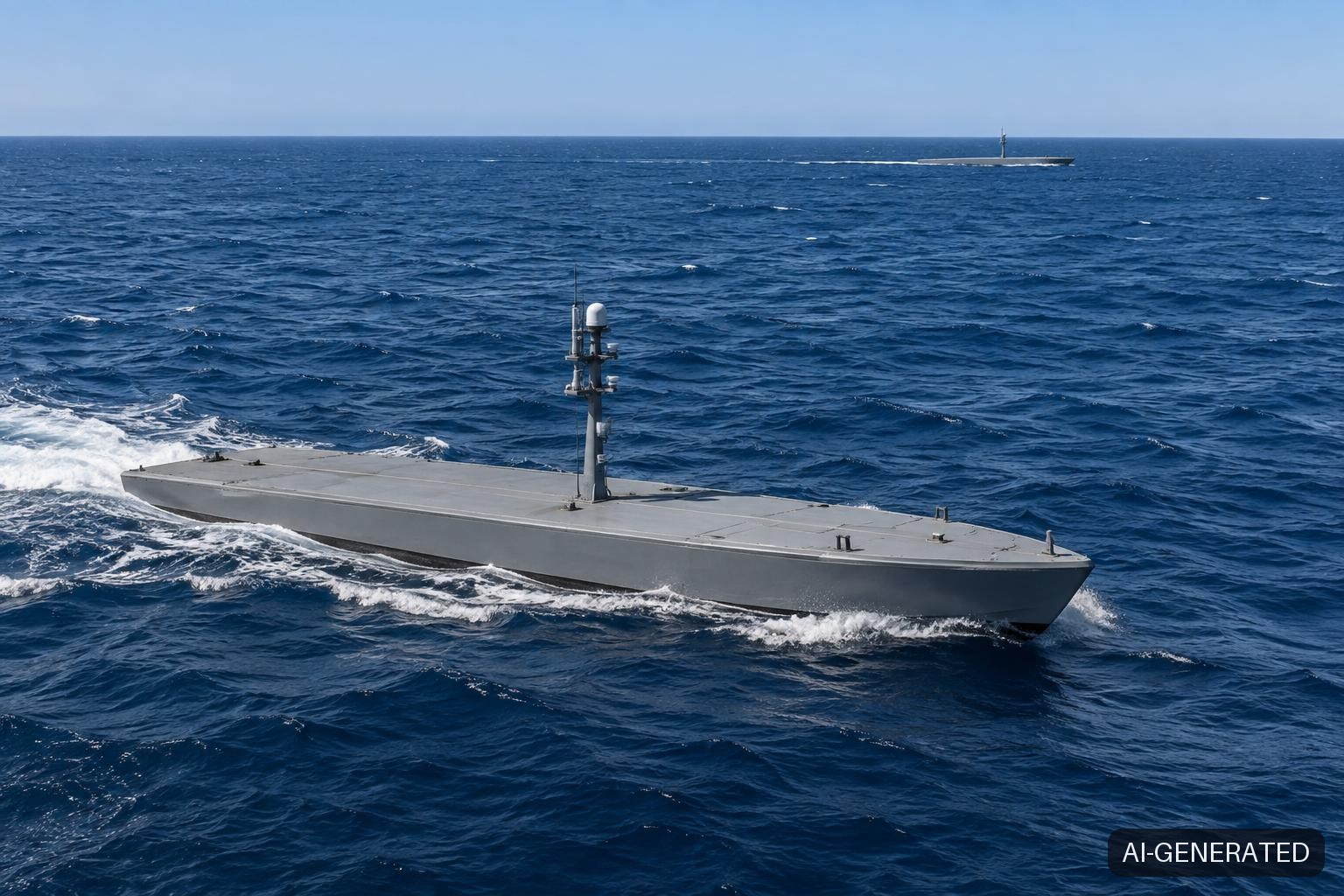
The U.S. Navy has awarded production contracts to three companies to build 30 Medium Unmanned Surface Vessels, making its most concrete commitment yet to fielding an operational fleet of autonomous surface combatants. The contracts, announced September 29, 2026, went to Galliano Marine Services, Huntington Ingalls Industries, and Saronic Technologies, with each vessel priced at approximately $40 million. The awards mark the transition from validated prototypes to production hardware under the Navy's Medium Unmanned Surface Vessel Family of Systems program, following the successful completion of phase one at-sea testing by all three companies.
Breaking Defense reported the contracts as entry into the second phase of the MUSV program, framing them alongside a broader expansion of the service's marketplace for unmanned systems. That marketplace framing matters: the Navy is not running a conventional winner-take-all shipbuilding competition but is instead building a vendor ecosystem designed to sustain multiple producers and diverse platform designs over time★.
From Prototype to Production: How the Program Got Here
The MUSV Family of Systems program has followed a deliberately staged competitive structure. In May 2026, USNI News reported that the Navy had selected seven MUSV designs to enter a prototype and at-sea demonstration phase, with each industry partner required to prove system maturity ahead of an October 2026 deadline. USNI News quoted the program's requirements directly: industry partners "must successfully complete at-sea demonstrations to prove the maturity of their systems"—language that established a clear performance threshold between prototype funding and production commitment. At that stage, the Navy indicated it planned to make vessels available for Navy leasing or procurement starting in fiscal year 2027—an unusual dual-track acquisition model that signals flexibility in how the service intends to absorb new platforms into the fleet.
The September contract awards confirm that three of the seven prototype competitors successfully completed phase one at-sea testing and advanced to production★. The September 29 awards, arriving before the program's stated October 2026 at-sea demonstration deadline, confirm that all three vendors cleared that threshold within the compressed four-month window between the May prototype selection and the production milestone★. The structured gate between prototype and production—requiring real-world sea demonstrations rather than laboratory validation alone—reflects the Navy's intent to field vessels with demonstrated performance in realistic maritime conditions before committing procurement funding.
At roughly $40 million per vessel across 30 units—a figure Navy Times reported as "around $40 million" across three distinct hull designs from separate vendors★—the program represents a procurement commitment in the range of $1.2 billion★, though exact contract totals were not itemized in available reporting. That figure underscores the scale at which the Navy is now moving: this is no longer a demonstration program but a production program with delivery obligations, acceptance testing timelines, and fleet integration requirements attached.
A Multi-Vendor Strategy for the Autonomous Surface Fleet
The decision to award contracts to three separate companies rather than a single integrator reflects the Navy's Family of Systems approach, which treats MUSVs not as a single standardized design but as a portfolio of platforms potentially optimized for different operational roles★.
Galliano Marine Services, while less publicly prominent, earned its production contract on the same competitive terms as its better-known competitors—completing the same phase one at-sea testing requirements and clearing the same evaluation bar. Navy Times confirmed that all three firms were selected "after the three companies completed phase one of at-sea testing for its Medium Unmanned Surface Vessel Family of Systems program," underscoring that production eligibility was determined by demonstrated performance rather than by criteria unrelated to system capability. That parity signals that the Navy's process rewarded demonstrated system performance over company profile or existing contract relationships.
HII's participation carries its own programmatic significance. The company's engagement in unmanned surface vessels signals that major defense primes view autonomous maritime platforms as a substantive growth area rather than a peripheral experimental effort.★
The simultaneous operation of production contracting and continued vendor enrollment indicates the Navy intends to preserve competitive options and design diversity even as the first production wave gets underway.★ The four companies that entered prototype testing but did not receive September production contracts may still find pathways through the expanding marketplace mechanism.★
MUSVs in the Broader Unmanned Systems Modernization Strategy
Breaking Defense specifically noted that the September 2026 contracts arrive "as the Navy expands its marketplace for unmanned systems"—framing the production awards as concurrent with, rather than the conclusion of, the service's broader unmanned surface program development. The marketplace expansion, as Breaking Defense characterized it, runs alongside production contracting rather than replacing the competitive vendor enrollment process that brought new designs into the MUSV program.★
Phase one at-sea testing was explicitly structured to validate those parameters before the service committed procurement funding, and the three contract awards represent the direct operational output of that process.
What Comes Next
The FY2027 vessel availability target, established in the Navy's program planning as reported by USNI News in May 2026, gives fleet commanders and program managers a rough delivery horizon. USNI News's May 2026 reporting tied that availability timeline explicitly to the completion of at-sea demonstrations prior to October 2026—a condition now confirmed met by all three production contractors★. USNI News also characterized the integration model as the Navy planning to "work with industry to have vessels available for Navy leasing or procurement"—language suggesting a collaborative rather than purely directive relationship between the service and its production contractors during the initial delivery phase. If production timelines hold across all three vendors, operational evaluation and early fleet integration activities could begin within roughly a year of the September 2026 contract awards. The Navy's inclusion of a leasing option alongside direct procurement—noted in the May 2026 USNI report—may provide additional flexibility to bring vessels into operational contexts ahead of full ownership commitments, a mechanism that could accelerate early fleet learning without waiting for full production delivery.
All three contractors now transition from competitive demonstrators to production contractors responsible for repeatable manufacturing, quality assurance, and government acceptance testing. That transition has historically been where promising defense platform programs encounter the most significant friction, and managing three vendors producing distinct designs adds coordination complexity for Navy program managers overseeing integration standards, logistics, and fleet doctrine development.
For HII, it extends a long-established Navy relationship into an emerging platform category with significant growth potential.
Thirty autonomous surface vessels will not transform the Navy's force structure on their own, but the MUSV program's progression from concept to competitive prototyping to production contracts in a compressed timeline demonstrates that the service can advance unmanned maritime platforms through the acquisition cycle at a pace more consistent with modern technology development than traditional capital shipbuilding. How effectively those vessels are integrated into fleet doctrine and operations—and whether the marketplace model sustains competition and innovation through subsequent procurement tranches—will ultimately determine whether the program delivers on its broader strategic ambitions.
★ AI inference: One or more analytical conclusions in this article were drawn by the AI from cited facts and are not directly stated in the cited sources.