
The final week of September 2026 produced a concentration of capital deployments and programmatic announcements that, taken together, trace the contours of where institutional money and military planning are aligning: in-space manufacturing, on-orbit services, and the electromagnetic environment that increasingly underlies modern ground combat. Varda Space Industries closed a $251 million Series D. Blackswan Space secured a €2.5 million seed round for a rendezvous and proximity operations technology demonstration. The U.S. Army announced a $7 billion counter-drone contract vehicle covering sensors, effectors, and command-and-control systems. These are distinct events across different market segments, but the investment logic and doctrinal priorities driving each of them point toward the same underlying shift in how commercial operators and armed forces intend to use near-Earth space over the next decade.
Varda and Blackswan Signal Investor Appetite at Opposite Ends of the Funding Spectrum
Varda Space Industries' Series D, led by Lux Capital and Natural Capital, values the company at $1.6 billion and brings its total capital raised to $598 million, according to Varda's announcement. The round is directed at scaling Varda's microgravity-enabled pharmaceutical processing platform, which leverages the orbital environment to manufacture drug compounds that are difficult or impossible to produce at terrestrial scale★.
At the other end of the capital range, Blackswan Space closed a €2.5 million seed round timed to fund the first in-orbit demonstration of its RPO Kit payload. Rendezvous and proximity operations technology sits at the confluence of commercial satellite servicing, space domain awareness, and national security interest — a combination that has attracted growing attention from both venture investors and government customers. The seed round, modest by late-stage standards, reflects the milestone-driven logic of the on-orbit services market: Blackswan's near-term objective is demonstrating that the payload performs as designed in the actual space environment, establishing the flight heritage that enables subsequent commercial and government contract pursuit. The in-orbit demo is the company's stated immediate next milestone, and the round is sized to get there.★
Grovewire has tracked the capital build-up in commercial space services across 2026.
Army's $7B Counter-Drone Vehicle Reflects Spectrum-Centered Warfighting Doctrine
The U.S. Army awarded an indefinite-delivery, indefinite-quantity contract vehicle worth up to $7 billion to 10 companies covering counter-unmanned aircraft systems technology across three functional categories: sensors for detection and tracking, effectors for neutralization, and command-and-control systems for integrating those layers into a coherent operational response. Brent Ingraham, heading the Army Secretariat's Office of Acquisition, Logistics and Technology, confirmed the award structure to reporters. The Pentagon's joint counter-drone coordination task force, JIATF-401, separately confirmed to DefenseScoop that the vehicle is on track to reach its $7 billion ceiling over its intended lifespan.
The IDIQ structure gives the Army flexibility to shift emphasis between sensor, effector, and C2 vendors as threat profiles evolve — a deliberate design choice given how rapidly drone technology has changed in recent operational environments. Individual task orders will determine the actual distribution of ceiling across the 10 awardees, meaning competitive dynamics within the vehicle will play out over years rather than resolving at award. The scale of the contract — $7 billion across a multi-year horizon — signals that the Army treats counter-drone capability not as a supplementary procurement but as a first-tier modernization priority.
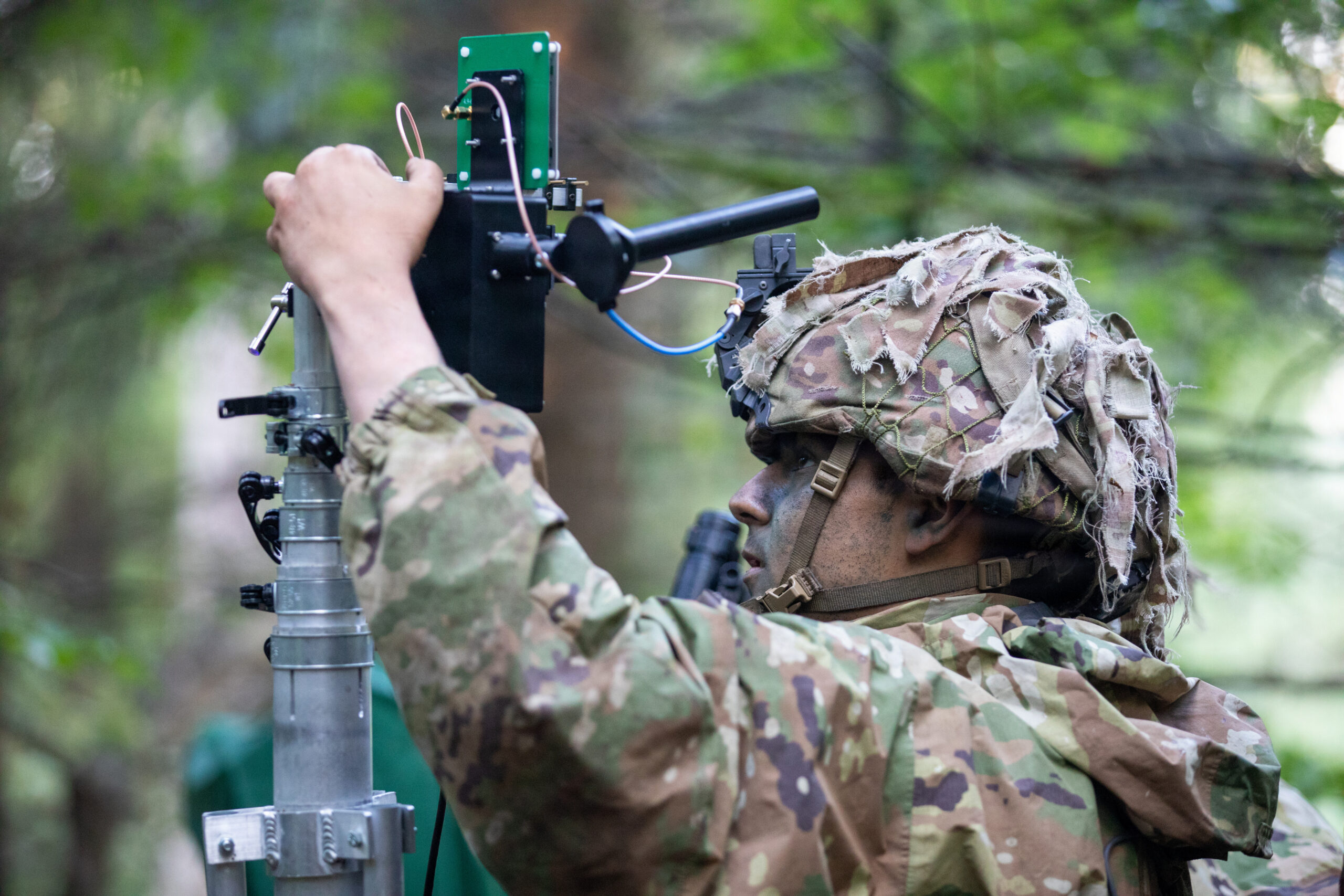
That priority is being shaped by a broader doctrinal evolution the Army has been articulating publicly. Breaking Defense published an analysis the same week framing electromagnetic spectrum ownership as the service's next generational imperative, drawing an explicit parallel to how investment in night-vision technology came to define U.S. ground combat advantage in the 1980s and 1990s★. Spectrum awareness, resilient connectivity, and electronic warfare defenses are being positioned as prerequisites for decision advantage in environments where drone operations, jamming, and communications disruption are routine rather than exceptional conditions. For the satcom sector, this framing carries direct procurement implications: military demand for jam-resistant, low-probability-of-intercept, spectrum-agile communications links is a durable driver that feeds into satellite architecture decisions, ground terminal requirements, and waveform development across both government and dual-use markets.
The counter-drone IDIQ and the spectrum doctrine are operationally linked. Effective counter-drone systems — particularly those relying on radiofrequency detection, electronic effectors, or directed-energy — are spectrum-intensive by design.★ The Army's emphasis on owning the spectrum rather than simply operating within it implies that procurement across both domains will increasingly require vendors to demonstrate interoperability and spectral deconfliction rather than peak point performance on isolated systems.★ Companies with combined sensor-effector-C2 portfolios, or those able to demonstrate cross-domain integration, are positioned more favorably within the IDIQ structure than single-function vendors.★
Starship's 14th Flight Demonstrates Operational Payload Deployment at Scale
SpaceX's 14th Starship integrated vehicle test flight reached orbit and subsequently deployed 26 Starlink V3 satellites over approximately 30 minutes using a sequential payload release mechanism SpaceX refers to as the "Pez dispenser" system, according to Payload's reporting. The flight marks a meaningful program transition: from demonstrating that Starship can reach and survive orbital velocities, to demonstrating that it can execute a functional commercial mission in the process. The V3 Starlink satellites represent the next generation of SpaceX's broadband constellation★, and their deployment from Starship rather than Falcon 9 has direct implications for the economics of constellation scaling at volume★.
If the deployment architecture proves reliable across subsequent missions, Starship could enable Starlink constellation refreshes and expansions at a per-satellite launch cost and per-flight throughput that Falcon 9 cannot approach★. For the broader satcom sector, the implications extend beyond SpaceX's own programs: a vehicle capable of delivering dozens of large-format satellites per flight could materially accelerate the planning horizons for other operators considering constellation builds or replenishments★.
Capital Concentration and Defense Procurement on Parallel Tracks
The week's activity, read as a set, reflects a market in which institutional capital is concentrating around demonstrated orbital capability rather than projected potential, and in which military procurement is moving toward high-ceiling, multi-vendor contract vehicles rather than single-award development programs. Varda's $1.6 billion valuation is grounded in flight-proven reentry hardware★. Blackswan's demo-focused seed reflects the milestone logic of on-orbit services investment. The Army's $7 billion IDIQ creates a durable procurement runway for companies able to perform across sensors, effectors, and C2, while the spectrum ownership doctrine signals that adjacent satcom and electronic warfare vendors should anticipate continued demand pull from the same operational requirement set. Starship's V3 deployment demonstrates that the heavy-lift vehicle required to sustain large LEO constellations at scale is becoming operational★. These developments are not coincidental; they reflect coordinated acceleration across the commercial and defense space sectors toward a shared infrastructure defined by resilient, spectrum-agile, space-enabled connectivity.
★ AI inference: One or more analytical conclusions in this article were drawn by the AI from cited facts and are not directly stated in the cited sources.