
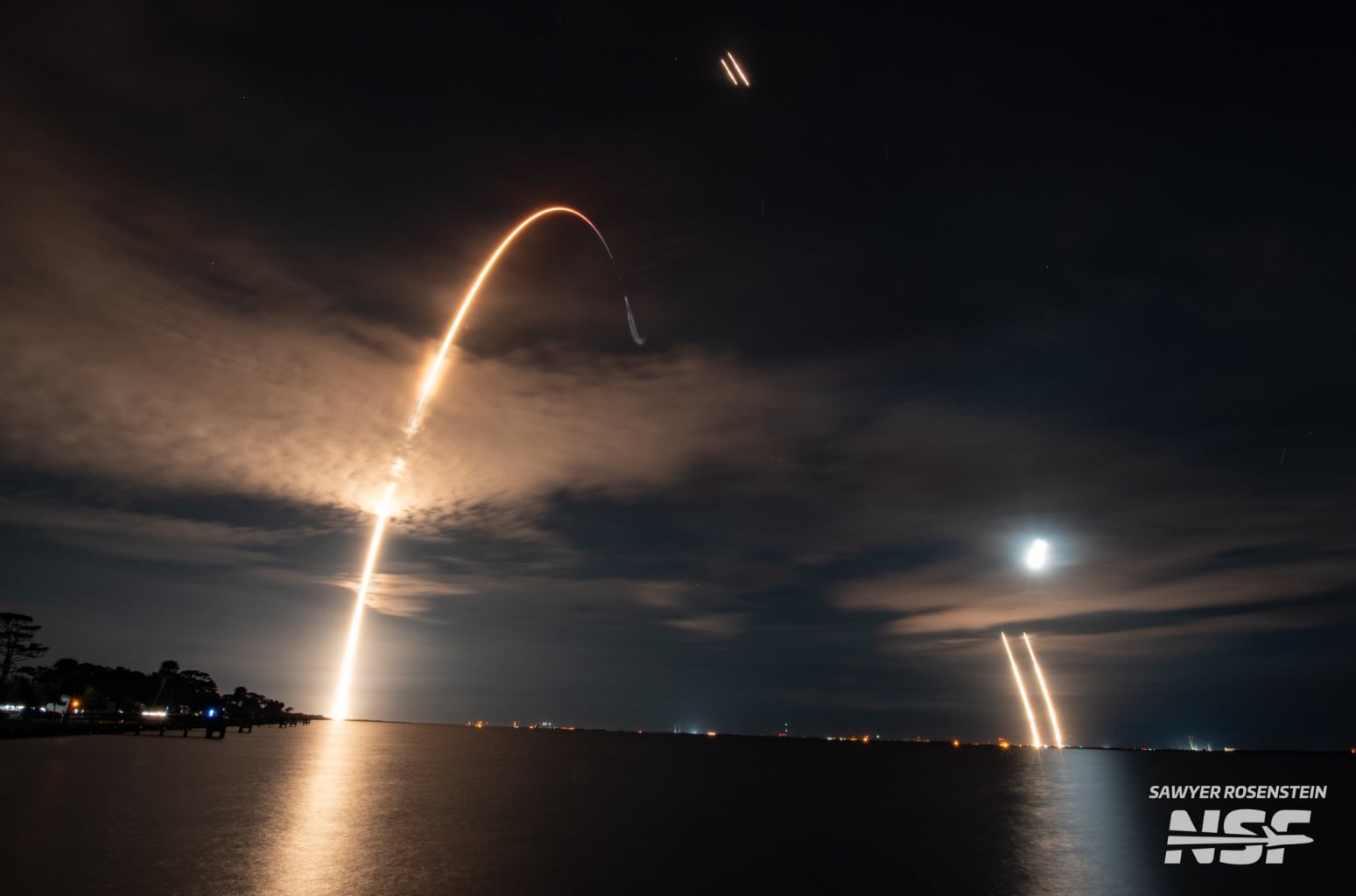
SpaceX's Falcon Heavy rocket flew its inaugural classified mission for the National Reconnaissance Office late Thursday night, delivering the NROL-97 payload to a high-energy orbit and anchoring a day in which the company recovered four separate boosters — a new operational record that illustrates how thoroughly SpaceX has come to dominate the U.S. national security launch market. Space.com characterized the overnight sequence as a tripleheader, with NROL-97 completing SpaceX's third successful launch in less than 13 hours — a compressed window that, combined with four successful booster recoveries, established a new benchmark for rapid-cadence national security launch operations.
The Mission and the Milestone
The NROL-97 mission lifted off from Launch Complex 39A at Kennedy Space Center at approximately 03:54 UTC on October 2, meaning the launch occurred just before midnight Eastern time★. NASASpaceFlight.com confirmed the mission's classified status and its high-energy orbit destination ahead of flight, providing one of the few specific technical characterizations the NRO routinely permits in pre-launch public reporting; post-launch records in Launch Library 2 log the outcome as successful, with the mission carrying a Government/Top Secret payload for the NRO. The specific orbital regime was not publicly disclosed, in keeping with standard NRO practice.
The flight marks the first time Falcon Heavy has been assigned to an NRO mission. That distinction matters because it signals the agency is now drawing on the vehicle's additional lift capacity for payloads or trajectories that go beyond what the workhorse Falcon 9 can efficiently serve. Spaceflight Now noted the mission's historic character in its coverage, framing NROL-97 explicitly as Falcon Heavy's first assignment from America's primary spy satellite agency. Space.com, in its own account, described the NRO as the agency "which operates the United States' fleet of spy satellites" — a characterization that frames the programmatic weight of certifying a second SpaceX vehicle class for the NRO's operational manifest. Expanding that relationship to cover Falcon Heavy effectively gives SpaceX access to the full range of the NRO's mass-to-orbit requirements.
The payload itself remains entirely classified beyond its mission designation. NROL-97 provides no public indication of satellite type, intended function, or specific orbital parameters.
Four Boosters, Thirteen Hours
The record that accompanied NROL-97 extended well beyond the mission itself. Teslarati reported that SpaceX landed four separate boosters within a single calendar day, a new operational benchmark for the company. Three of those recoveries came from the NROL-97 flight itself: Falcon Heavy's two side boosters, which routinely return to landing zones near the launch site following separation, and the center core.★ The fourth recovery came from a separate Falcon 9 mission that flew earlier the same day.★
Space.com reported that NROL-97 was the third SpaceX launch in under 13 hours, meaning the company executed a full tripleheader across a compressed overnight window on October 1–2. Space.com headlined its coverage "3 for 3," capturing the sequential character of three successful launches each paired with booster recovery★. That cadence — multiple national security and commercial missions completed in rapid succession, with hardware recovered after each — represents a level of throughput that would have been operationally unworkable for any U.S. launch provider just a few years ago. SpaceX has built this capability through sustained refinement of its booster recovery and refurbishment pipeline, and the result is a tempo that competitors have not been able to replicate. Teslarati's coverage noted that the four-booster landing record was set "quietly" — a descriptor that underscores how routine SpaceX's operational pace has become, even as individual achievements within that pace remain genuinely significant.
The four-booster landing record is not merely a headline achievement. For defense program managers, the ability to recover and reuse hardware is directly relevant to launch cost economics across sustained manifests. As the Department of Defense continues to invest in resilient satellite architectures and proliferated LEO constellations, launch unit cost and schedule reliability become consequential variables in constellation build-out planning. A provider that can execute multiple government launches in a single day while recovering every booster provides a substantially different operational proposition than one operating on expendable vehicles with longer turnaround cycles.
SpaceX's Defense Footprint Continues to Expand
NROL-97 lands at a moment when SpaceX's national security launch activity has broadened across vehicle types, orbital regimes, and government customers. Less than a week before the Falcon Heavy flight, a Falcon 9 Block 5 vehicle launched from Space Launch Complex 4E at Vandenberg Space Force Base on September 26, 2026 at approximately 14:00 UTC on a mission designated USSF-385, delivering a classified payload to low Earth orbit on behalf of the U.S. Space Force. Launch Library 2 records note that the stage drop-zone geometry for USSF-385 exact fits with previous Starlink Group deployments, and flagged the possibility — unconfirmed — that the satellites were built on SpaceX's Starshield bus. The pairing of a Florida-based high-energy NRO flight with a California-based LEO Space Force mission across consecutive calendar weeks reflects how broadly SpaceX's national security work now spans orbital regime, launch site, and government customer.
Taken together, USSF-385 and NROL-97 illustrate a pattern of SpaceX executing classified DoD missions at increasing frequency across its full vehicle family. Falcon 9 handles LEO national security missions; Falcon Heavy is now certified for higher-energy NRO payloads★; and the Starshield satellite bus appears active in Space Force constellation production★. This layered participation — as both launch provider and probable satellite manufacturer — gives SpaceX an unusually deep footprint in the government space segment★, one that extends beyond the transactional launch relationship more traditional contractors maintain.
The NROL-97 mission adds another dimension to that institutional relationship: SpaceX is not simply a contractor delivering payloads on government schedules, but is increasingly integrated into the infrastructure through which the United States sustains its space-based intelligence posture.
Programmatic Implications and Near-Term Outlook
From a vehicle-certification standpoint, Falcon Heavy's entry into the NRO manifest is likely to persist. A successful inaugural NRO flight strengthens Falcon Heavy's standing as the default option for high-energy government missions that exceed what Falcon 9 can efficiently support. NROL-97's successful completion removes the programmatic uncertainty that surrounds any rocket's first mission in a new mission category.
The week's classified launch activity — USSF-385 for the Space Force on September 26 and the NROL-97-anchored tripleheader on October 2 — placed government payloads on orbit at two different orbital regimes from two different launch sites within a seven-day window, spanning both U.S. coasts★ and two distinct vehicle classes. That density of activity provides a concrete reference point for program managers evaluating SpaceX's capacity to absorb concurrent classified assignments without schedule degradation.
The operational tempo established around this launch also has implications for the satcom and commercial launch sectors. Falcon Heavy now carries an NRO mission on its ledger — a data point that signals confidence in the vehicle's ability to perform on high-value, low-margin-for-error assignments.
The next trackable milestones for this program area are likely to involve further USSF Starshield constellation expansion★ and any additional Falcon Heavy NRO assignments that surface through government launch manifest disclosures. The pace of classified DoD launch activity through late September and early October 2026 suggests both programs are advancing on compressed timelines.
★ AI inference: One or more analytical conclusions in this article were drawn by the AI from cited facts and are not directly stated in the cited sources.