
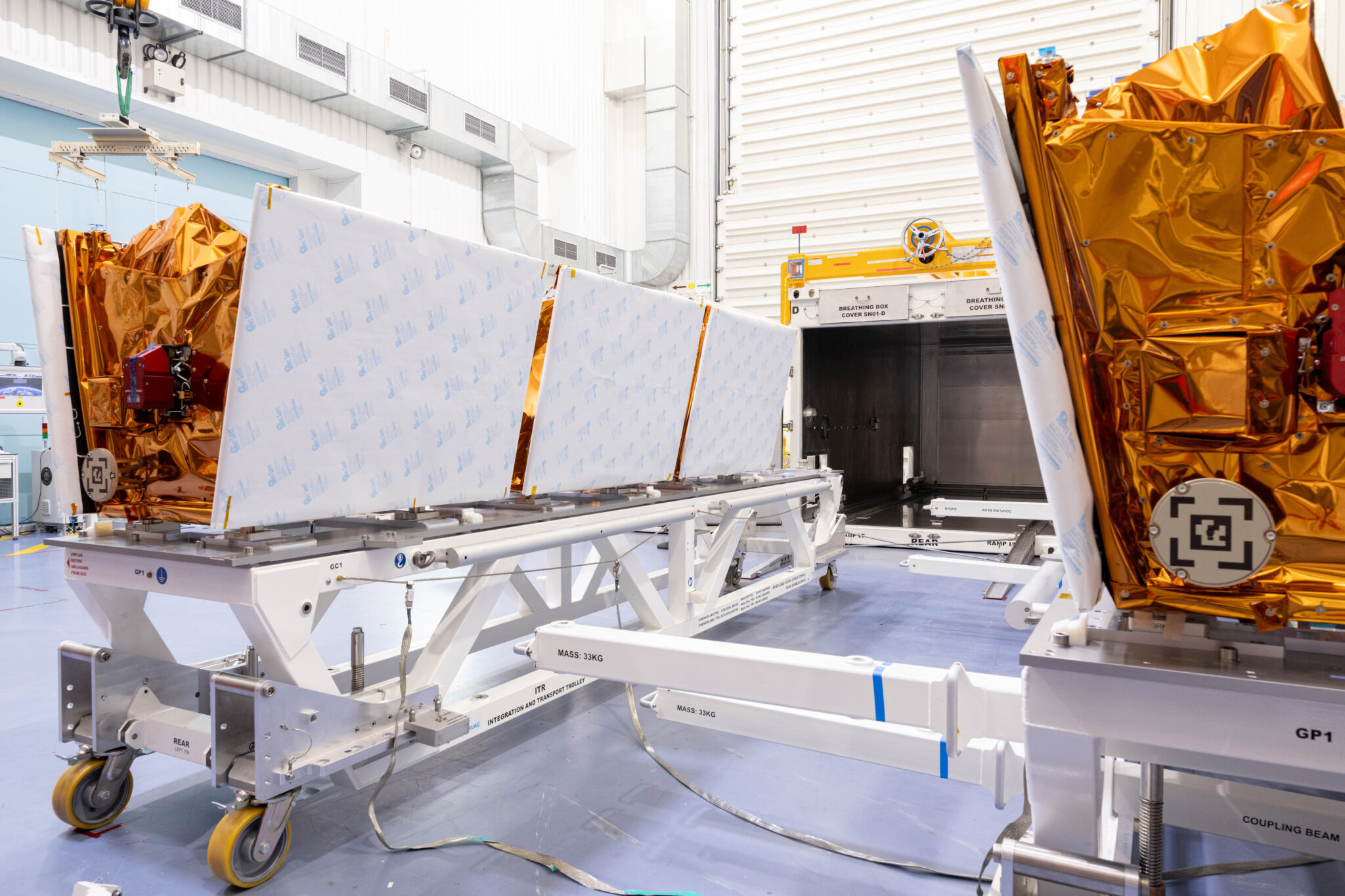
Eutelsat's program to renew and enhance the OneWeb low Earth orbit constellation passed a major manufacturing milestone on October 2, 2026, as Airbus Defence and Space completed and delivered the first 32 next-generation LEO satellites. The spacecraft were produced at Airbus's dedicated constellation satellite production facility in Toulouse, France, and are now being prepared for shipment to a launch site in the United States. The hardware handover marks the point at which the refresh program transitions from program planning into active delivery — a distinction that carries practical weight for an operator whose competitive position depends on keeping its constellation technically current.
The announcement was issued by Eutelsat on October 2 and covered by Via Satellite. The successful delivery of this first batch demonstrates the industrial pipeline is functional and capable of supporting the subsequent batches that a full constellation renewal will require.★
Manufacturing Scale and European Industrial Significance
Airbus Defence and Space's Toulouse facility is the designated production center for the next-generation OneWeb satellites, and its demonstrated ability to deliver 32 spacecraft in a single completed batch positions it as a substantive node in Europe's commercial LEO satellite supply chain. Producing at this throughput level reflects the broader shift that has reshaped satellite manufacturing: constellation programs now require industrial processes more akin to high-volume aerospace component production than to the low-rate, individually-managed manufacturing that characterized the geostationary era. The Toulouse facility's performance on this program provides concrete evidence that European industry can sustain that kind of output at commercial scale.
For European aerospace and policy stakeholders, the production milestone carries significance beyond the immediate commercial program. That policy impetus to strengthen indigenous European space capability increases the strategic visibility of large-scale satellite manufacturing conducted on the continent. An industrial base capable of producing LEO constellations at meaningful throughput supports not only commercial operators but also the broader argument — increasingly prominent in European defense and industrial policy discussions — that Europe can sustain independent access to advanced space systems without sole reliance on non-European suppliers.
The next-generation designation applied to these 32 satellites indicates that they incorporate performance advances relative to the existing OneWeb fleet★, consistent with Eutelsat's stated objective to renew and enhance the constellation. The specific technical characteristics of the upgraded spacecraft — mass, onboard power, frequency configuration, or throughput improvements — are not detailed in the sources available. What is confirmed is that production was completed ahead of the launch campaign, meaning hardware readiness will not be a constraint on near-term scheduling. For a constellation refresh program that will require multiple production batches over an extended period, on-time delivery of the first batch is an operationally meaningful signal for the program's downstream execution risk.
Beyond immediate program metrics, the sustained manufacturing workload that the OneWeb refresh represents matters to the European industrial ecosystem more broadly. Satellite production is upstream of launch demand; a multi-batch constellation refresh program keeps production lines active★ and supports the skilled engineering workforce and supply chain associated with Toulouse's aerospace cluster. For the European space sector, which is navigating a competitive transition from low-volume geostationary manufacturing toward higher-volume LEO production, a program of this scale provides the kind of sustained pipeline that enables industrial continuity and capability development over time.
Launch Planning: Near-Term U.S. Campaign and Arianespace's Forthcoming Role
The 32 completed satellites are being prepared for shipment from Toulouse to a launch site in the United States, where the first launch in the refresh campaign is described as upcoming. The launch vehicle and provider for this initial batch have not been identified in the sources reviewed. The broader launch architecture for the refresh program came into clearer focus in mid-September, when Eutelsat announced that it had selected Arianespace to conduct two dedicated launches for the OneWeb LEO constellation — a decision made roughly three weeks before the first satellite delivery milestone.
The Arianespace contract, announced September 10, adds European launch capacity to what Eutelsat described as its diversified options for access to space. That framing reflects a deliberate multi-provider procurement philosophy rather than exclusive reliance on a single supplier★. For an operator managing a large constellation with ongoing deployment and refresh requirements, launch flexibility — the ability to utilize multiple vehicles and providers across different sites — is operationally important. Concentrating launch with a single supplier creates schedule dependency; diversification allows the program to manage delays and optimize cadence across a broader set of mission options.
The combination of a USA-based initial launch and the subsequent Arianespace contract illustrates that strategy in practice. The first deployment from U.S. territory may reflect current vehicle availability, launch slot scheduling, or other operational considerations that determined near-term timing. The Arianespace contract then secures European launch capacity for at least two follow-on missions★, maintaining a European provider's role in the program's long-term delivery architecture. The vehicle type, specific launch site, and timing for the Arianespace missions have not been specified in the September announcement.
Taken together, the Airbus Defence and Space manufacturing contribution in Toulouse and the Arianespace launch services contract give the program a notably European industrial character even as the initial deployment uses U.S. launch infrastructure. Spacecraft production and launch services represent two program segments in which significant industrial value is retained within the European space sector — a dimension that has gained salience as European governments and industry bodies discuss supply chain resilience and strategic autonomy in space.
Competitive Context and Program Outlook
For Eutelsat and the OneWeb constellation, the refresh program is a direct operational response to this environment. Allowing the existing fleet to age without replenishment would progressively reduce its performance and reliability relative to newer competing systems. Delivering 32 next-generation spacecraft on schedule demonstrates that program execution is tracking its plan★, though the broader question of whether the overall refresh pace is sufficient to sustain OneWeb's competitive positioning will be answered over the coming years as both deployment rates and market dynamics evolve.
With the first batch cleared for shipment, the program's immediate focus shifts to launch execution. The satellites must be transported from Toulouse to the U.S. launch site, then proceed through vehicle integration and range processing before liftoff. No confirmed launch date has been announced in the sources reviewed. Looking ahead, the two Arianespace launches contracted in September provide a confirmed pathway for subsequent deployment events★. The pace at which Eutelsat and Airbus can sustain batch deliveries will determine how quickly the constellation refresh translates from manufacturing milestone into improved orbital coverage and network capability. The sources reviewed describe the program as a commercial constellation renewal effort; specific government or dual-use applications planned for the next-generation OneWeb satellites are not addressed in the available materials.
★ AI inference: One or more analytical conclusions in this article were drawn by the AI from cited facts and are not directly stated in the cited sources.