
On October 5, 2026, a cluster of procurement awards and program milestones landed within hours of one another, spanning ground-based air defense, autonomous combat aviation, and space-based intelligence infrastructure. Considered individually, each event is significant. Considered together, they outline a defense posture that is deliberately building resilience across every warfighting domain simultaneously—and wrestling with the question of whether the space layer, in particular, can sustain the operational demands being placed on it.
Air Defense: A $14.7 Billion Seeker Contract and Regional Arms Approvals
Boeing secured a potential $14.7 billion contract to produce PAC-3 missile seekers, awarded as an undefinitized contract action by Lockheed Martin, which serves as the prime contractor for the Patriot Advanced Capability-3 program.
On the same day, the State Department approved a proposed Foreign Military Sale to the United Arab Emirates worth approximately $1 billion, covering Advanced Patriot Guidance Enhancement Kits and associated repairs. The UAE package was part of a broader set of regional approvals that also included Javelin anti-tank missiles for other Middle East partners. The simultaneous domestic production award and allied sales approvals represent a two-track approach: expanding U.S. manufacturing output while working to ensure that partner nations who depend on Patriot as their primary air defense layer maintain adequate operational stocks. For defense industrial planners, the critical variable is how quickly Boeing can execute on seeker production given existing supply chain conditions and how that capacity interacts with the Patriot system's broader component base.
Talon Blue Completes a Full Autonomous Sortie at Mojave
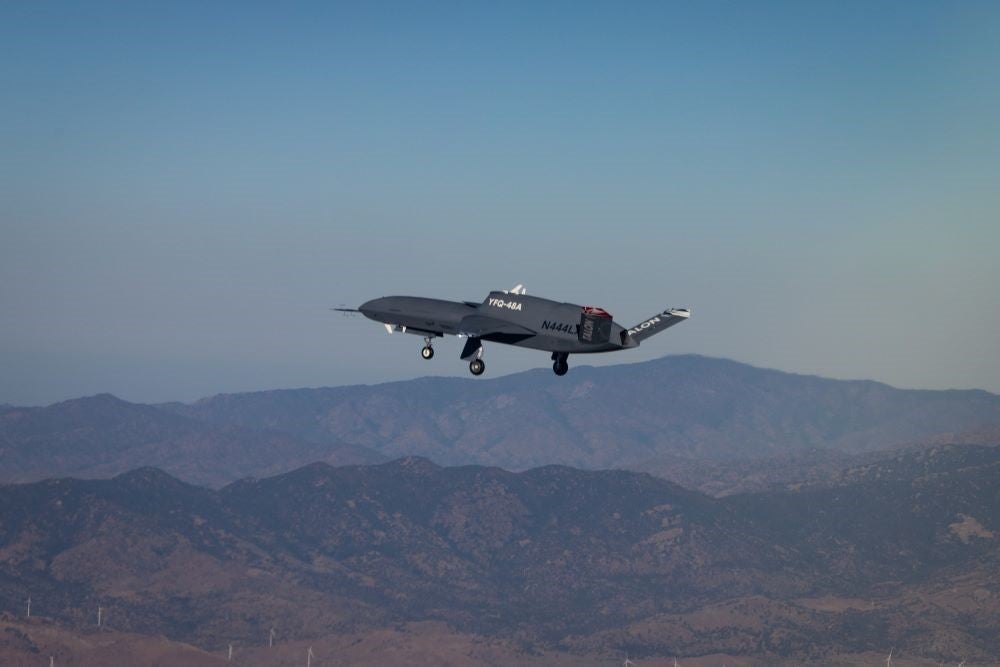
Northrop Grumman's YFQ-48A Talon Blue Collaborative Combat Aircraft completed its first flight on October 3 from Mojave Air and Space Port in California★, with the company's public announcement following on October 5. The sortie was conducted under fully autonomous control throughout, encompassing taxi, takeoff, in-flight maneuvering, and landing—a complete mission profile executed without crew input. Northrop funded the development using internal research and development resources rather than under a direct government contract, a corporate risk posture that signals genuine confidence in the Air Force's Collaborative Combat Aircraft acquisition trajectory and the company's intent to compete for a meaningful position in that program.
The Talon Blue's debut places Northrop in direct competition for the Air Force's future combat fleet at a moment when that competition is becoming increasingly concrete. Air & Space Forces Magazine noted that the first flight heightens the contest for the USAF's CCA portfolio. For program offices and operators, the significance of the October 3 flight lies in its scope: autonomous taxi, takeoff, and landing on a purpose-designed combat aircraft—rather than a converted civilian or trainer platform★—indicates that the integration of propulsion management, flight control software, and onboard sensing has progressed to the point where operationally representative missions are within reach. The relevant question for defense buyers is no longer whether CCA autonomy is technically achievable, but how quickly it can be certified for operational use and integrated with existing manned fleets at scale.
The Talon Blue program sits squarely within the scope of that office's mandate, and its self-funded first-flight milestone gives Northrop a credible technical footprint ahead of any formal downselect. More broadly, the CCA concept—affordable autonomous wingmen that multiply the effective sortie rate of manned strike packages without proportional aircrew costs—has moved from Air Force concept exploration into a competitive industrial race with multiple credible entrants.
Kratos Logs $100 Million-Plus in Space Intelligence and Cyber Contracts
Kratos Defense & Security Solutions disclosed contracts totaling more than $100 million in combined value covering space intelligence data and cyber capabilities, according to a report published October 5. The awards span multiple contracts rather than a single program, reflecting Kratos's position across a range of government space and cyber programs.
The Kratos contracts land against a backdrop of widening debate over whether U.S. space-based strategic systems—including large constellations being built for missile defense and tactical communications—have adequate sustainment architectures to remain operationally effective under adversary pressure. In a sponsored commentary published by Breaking Defense, former Missile Defense Agency Director Lt. Gen. (ret.) Trey Obering said that on-orbit servicing could enhance orbital resilience for the Golden Dome homeland missile defense concept. Obering's argument centers on orbital resilience: satellites that cannot be refueled, repaired, or repositioned after launch impose inherent operational limits that no amount of ground-based logistics can overcome★, and a proliferated constellation operating in a contested environment would require the ability to reconstitute or extend asset life in orbit to remain viable across a conflict's duration★.
On earlier investment rounds in rendezvous and proximity operations technology bear directly on the sustainment challenge Obering describes. As the Pentagon's satellite architectures scale toward hundreds of nodes, the per-unit replacement cost and reconstitution timeline grow more consequential, and the case for in-space maintenance and servicing relative to build-and-replace cycles strengthens commensurately. Obering's commentary—whatever its sponsored framing—reflects a question that program offices will have to answer as Golden Dome and similar systems move from concept to procurement.
Looking ahead at the near-term orbital calendar, SpaceX's CRS-35 Dragon cargo mission is scheduled to depart Space Launch Complex 40 at Cape Canaveral on October 13 under NASA's second Commercial Resupply Services contract—the 35th such mission to the International Space Station. While ISS resupply is civilian rather than defense infrastructure, the regularity and reliability of the CRS cadence represents a mature reference model for sustained orbital logistics that defense planners are working to replicate for national security constellations.
Structural Linkages and Industrial Constraints
Read together, the October 5 developments trace an integrated, if not centrally coordinated, effort to build defense resilience across kinetic, autonomous, and orbital layers. The viability of space-based strategic systems depends on the kind of on-orbit resilience that, as Obering argues, current procurement strategy has not fully resolved★. Vulnerability or bottlenecks in any one domain create cascading effects across the others.
For procurement professionals, the most immediate constraint remains industrial throughput. The PAC-3 award's undefinitized status means that production ramp schedules are still being negotiated★, and how quickly Boeing can scale seeker manufacturing will determine whether air defense inventories keep pace with demand from both domestic and allied customers★. Northrop's self-funded approach to Talon Blue compresses the timeline to a competitive CCA demonstration★ but defers the question of how the program transitions to a funded government contract★. And Kratos's space intelligence awards, while significant in aggregate, offer limited visibility into which specific capabilities the government is prioritizing or what additional contract opportunities may follow★. The multi-domain push is real and well-funded; the industrial execution challenge is where the details will matter most.
★ AI inference: One or more analytical conclusions in this article were drawn by the AI from cited facts and are not directly stated in the cited sources.