
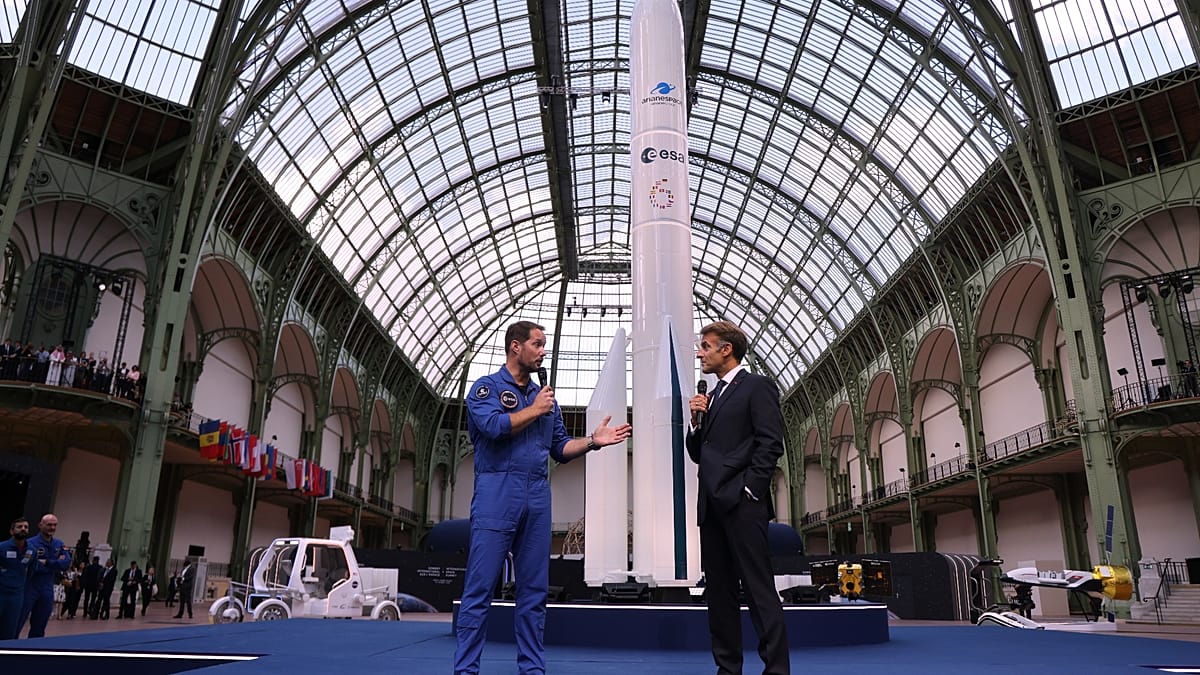
Germany's intelligence and defense establishment formally brought space operations to the top of its strategic agenda during October's International Astronautical Congress, with the country's intelligence community declaring space a masthead-level priority — a designation that positions satellite-based intelligence, communications, and surveillance capabilities on par with traditional security imperatives★. The announcement emerged during IAC 2026 and reflects a broader shift in how European governments are integrating space into national security architecture★ at a moment when the continent is actively working to reduce its reliance on externally controlled infrastructure.
The timing is not coincidental. Over the preceding weeks, European governments had grown more deliberate about defining what they want to own, operate, and control in orbit. The policy statements surfacing at IAC 2026 are the institutional expression of pressures that have been building across the European defense space market throughout the year★ — and the convergence of intelligence posture shifts, diplomatic coalition-building, and pre-conference strategic positioning makes October 2026 a meaningful inflection point for the sector★.
Germany's Intelligence Posture Shifts Toward Orbit
SpaceWatch.GLOBAL's IAC 2026 recap, published October 8, describes Germany's intelligence community as explicitly placing space on its strategic masthead — the kind of designation that, in institutional terms, signals resource commitment, organizational restructuring, and long-term capability development★. For German intelligence operators, this means satellite communications, space-based surveillance, and related orbital assets are no longer adjuncts to traditional intelligence methods but primary instruments of national security★.
That framing carries significant operational weight. Satellite communications infrastructure underpins secure command-and-control for military forces operating at extended range; space-based imagery and signals intelligence generate persistent situational awareness that ground-based collection cannot replicate in contested environments. By formally elevating these capabilities to strategic priority status, Germany's intelligence establishment is signaling that it views space not as a technical specialty but as a domain where national security outcomes are directly shaped. For the European satcom and space-intelligence sector, the practical consequence is that demand from German government customers — intelligence agencies, defense ministries, and the institutions connecting them — is likely to expand, and procurement priorities will shift accordingly★.
The IAC forum also provided a venue for regional space powers beyond Germany to articulate their own strategic positions. SpaceWatch.GLOBAL's Day Three recap, written by Torsten Kriening, describes a session in which regional blocs spoke with unusual directness about space ambitions and priorities★. The shift reflects how thoroughly the space domain has been absorbed into broader geopolitical and defense calculus across multiple regional actors simultaneously.
National Hands on Military Space: The European Space Shield Debate
Preceding IAC 2026 by roughly a week, a Euronews report from October 2 revealed that Germany and France are leading a coalition of seven European nations seeking to reshape the proposed European Space Shield. The coalition's core argument is that while the Shield should be designed to protect EU space systems collectively, military space capabilities — the satellites, ground infrastructure, and command architectures that directly serve defense functions — should remain under national control rather than be pooled into a supranational framework.★
That position represents a deliberate architectural choice with significant downstream implications. Pooling civilian or scientific space assets at the EU level can generate scale and efficiency; extending that same logic to military systems introduces hard questions about command authority, intelligence-sharing protocols, classification boundaries, and the speed of decision-making in crisis scenarios. Germany and France, along with their five co-signatories★, appear to be drawing a clear boundary: European solidarity in protecting shared assets, national discretion in wielding them operationally★.
For industry, the practical effect of a national-first military space posture is that procurement will flow through national defense ministries rather than through European joint programs, at least for the most operationally sensitive capability categories★. The European Space Shield architecture debate is not resolved★.
Sovereign Capabilities and a Reshaping Market
Defense News documented in late September that European demand for sovereign satellite capabilities is already reshaping the continent's defense space market, as governments seek greater control over the infrastructure they depend on operationally. That dynamic predates the IAC announcements and gives them important context: the policy statements at IAC 2026 are landing on a market that has been reorganizing around the expectation of increased national investment for several months.
The driver is not purely strategic preference. The lesson drawn by European capitals — that reliance on externally controlled satellite infrastructure creates operational vulnerability — is directly legible in the posture Germany is now formalizing at the intelligence-community level. Against that backdrop, the continued expansion of U.S. commercial LEO constellations provides the scale reference point European planners are measuring their sovereign ambitions against★; SpaceX successfully deployed another batch of 27 Starlink satellites to low Earth orbit in a mid-September launch, a routine operational tempo that underlines how rapidly the dominant commercial constellation architecture is consolidating★.
Europe's sovereign capability push is intersecting with a defense satcom market whose growth trajectory is well-established. Germany's elevated intelligence-community posture is, in that context, also a market signal to domestic and allied industry: invest in sovereign-grade capabilities, because the customer intent is genuine and institutionally grounded.
IAC 2026, Rome, and the Institutional Sequencing Ahead
Beyond the Germany-specific announcements, IAC 2026's third day addressed Europe's preparations for upcoming cooperative frameworks, with Rome cited as a near-term planning horizon. SpaceWatch.GLOBAL's recap covering this theme, also published October 8, indicates that European space actors are not merely reacting to individual pressures but actively sequencing their institutional steps toward a defined near-term decision point★. Preparation for a Rome-level forum implies a set of positions to be advanced, compromises to be negotiated, and resource commitments to be foreshadowed.
If Germany's elevated space posture — and the German-French coalition's stance on military space sovereignty under the European Space Shield — are being developed partly in anticipation of a Rome-adjacent summit, then IAC 2026 served in part as a pre-negotiation alignment exercise: a venue for coalition partners to signal positions to each other and to international stakeholders before the formal negotiating table is set★. That kind of preparatory signaling is a standard feature of multilateral space diplomacy, and its presence at IAC reinforces the degree to which the congress has evolved from a primarily scientific gathering into a genuinely strategic forum★.
The concrete milestones now visible include the Rome cooperative framework, where European positions on space sovereignty and Space Shield architecture will be formally advanced★; ongoing procurement decisions in Germany and coalition partner nations that will begin to reflect the elevated intelligence-community posture; and the continuing internal EU debate over collective versus national military space governance. What remains less transparent is the precise implementation pathway through which Germany will operationalize its strategic elevation of space — whether through expanded national satellite programs, expanded commercial contracting under government authority, or deepened bilateral arrangements. The posture is stated; the detailed architecture will emerge over time and is unlikely to be fully disclosed given the inherently classified character of intelligence operations. For satcom operators, Earth observation providers, and space-intelligence integrators with European government exposure, the directional signal is consistent: sovereign capability, national control, and reduced external dependence are the organizing principles of European defense space investment in the period ahead★.
★ AI inference: One or more analytical conclusions in this article were drawn by the AI from cited facts and are not directly stated in the cited sources.