
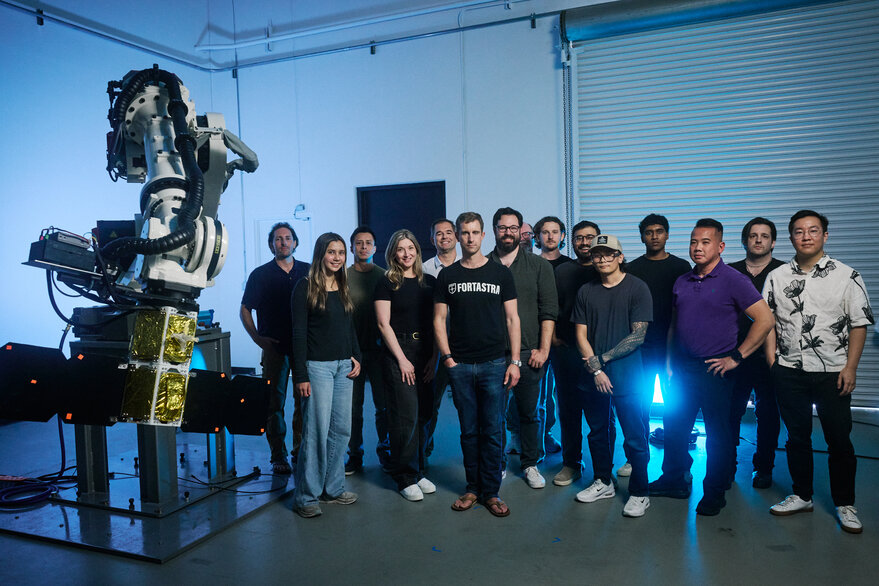
Fortastra, a Los Angeles-based startup developing maneuverable spacecraft for on-orbit security, closed a $30 million Series A funding round on October 8—capital it intends to direct toward scaling its next-generation security spacecraft as the U.S. military's presence in orbit expands to include weapons systems and a growing array of strategic assets. The raise positions Fortastra as one of the more credentialed entrants in an emerging commercial segment where private companies are stepping in to address capability gaps that government programs alone may not be able to fill at the pace military space operations now demand.
The company currently employs 18 people—a small but focused team for a firm that has already put hardware into orbit. SpaceNews reported that Fortastra expects to more than double its headcount over the next year to 18 months as it channels the new capital into accelerated development and operational expansion. That growth trajectory, from 18 to well above 36 employees within roughly a year★, implies the company has identified near-term engineering and business development needs significant enough to justify aggressive hiring in a labor market where cleared engineers with spacecraft experience remain scarce.
Funding Purpose and Recent Milestones
Fortastra's Series A is explicitly targeted at scaling maneuverable spacecraft for on-orbit security. Maneuverability is the defining technical characteristic of its product line: unlike conventional satellites that hold a fixed orbital position relative to other objects, a maneuverable security spacecraft can reposition itself in orbit to observe, respond to, or operate in proximity to other platforms. That capability is central to active orbital security in ways that passive surveillance assets are not, and it represents the technical foundation around which Fortastra has organized its development program.
The funding announcement came on the heels of several company milestones that Fortastra presented as evidence of technical and commercial progress ahead of the raise. The company has already launched Watchdog V0, a first-generation security spacecraft★ that delivered on-orbit operational experience before the Series A closed★. Having actual hardware in orbit is a meaningful differentiator at this stage: it gives Fortastra empirical performance data and reduces the technical risk profile that both investors and government customers must evaluate when deciding whether to back or contract with an early-stage company.
Also highlighted in the Series A announcement is a memorandum of understanding Fortastra signed with Hadrian, a manufacturer specializing in precision machining and additive manufacturing. The agreement is oriented specifically toward national security spacecraft programs—language that points to defense end-users and government missions rather than commercial satellite operators. For a company at Fortastra's current scale, formalizing a manufacturing relationship with a firm capable of delivering precision components at industrial volumes is a step toward production readiness. Fortastra's early move to establish that manufacturing foundation suggests the company is planning for a production-oriented phase, not just continued prototype development.
Military Orbital Expansion and the Security Imperative
The operational context surrounding Fortastra's raise is the direct driver of the sector it is entering. Payload noted in its coverage of the announcement that the U.S. military now has weapons in space and that the orbital arsenal is actively expanding—conditions under which securing those assets becomes a top operational priority for the Defense Department rather than a future planning concern. That framing is significant because it shifts the commercial orbital security conversation from speculative to operational: the assets exist, they are multiplying, and protecting them is a present-tense requirement.
Grovewire has tracked this trajectory closely in recent months.
As the military's orbital infrastructure grows more complex and operationally consequential, protecting it presents a correspondingly more demanding challenge. Fixed surveillance assets can monitor orbital environments, but active security—the ability to reposition in response to an approaching or interfering object—requires platforms that can maneuver.★ That is precisely the capability Fortastra is building, and the timing of this raise relative to the visible expansion of U.S. military space activities reflects a deliberate bet that the demand side of that equation is accelerating.
Commercial Companies Filling the Security Gap
The structural question underlying Fortastra's market position is how the Defense Department intends to acquire on-orbit security capability over time. Orbital security appears to be following a similar trajectory, with private capital now funding development of specialized security spacecraft oriented toward government customers.
Fortastra's $30 million raise is a relatively modest funding event in the context of overall defense-space investment★, but it is significant as a data point in the commercial orbital security ecosystem. The company is not building a general-purpose satellite or a launch vehicle—it is building a specialized security spacecraft with a defined national security orientation, as evidenced both by the Hadrian MOU's explicit reference to national security programs and by the nature of Watchdog V0 as a purpose-built security platform★. That specificity of mission focus, combined with on-orbit hardware already in operation★, gives Fortastra a more concrete commercial proposition than early-stage companies that are still defining their product around anticipated rather than demonstrated capability.
Private capital entering this domain at Series A stage also reflects investor confidence that the contracting environment will support follow-on commercial revenue★.
Near-Term Milestones and Open Questions
Fortastra's plan to more than double its workforce within 12 to 18 months of closing the Series A is the clearest publicly available signal of its near-term operational tempo. Growing at that rate requires hiring simultaneously across spacecraft engineering, operations, and program management functions★—a substantial execution challenge for any early-stage defense-oriented company.
The technical specifications of the next-generation security spacecraft the Series A is intended to fund have not been detailed in publicly available company disclosures.★ What Watchdog V0 demonstrated on orbit, and what the successor platform will advance beyond it, remain to be disclosed as development progresses.★ The Hadrian manufacturing partnership offers an early structural signal about the direction of the product roadmap—particularly the emphasis on production readiness—but specific capability improvements, mission architecture, and development timelines have not been publicly confirmed★.
What is clear is that Fortastra has moved beyond concept-stage positioning. It has on-orbit hardware, a manufacturing partnership explicitly oriented toward national security customers, and now the capital to pursue next-generation development at scale. The orbital security market it is entering is real, growing, and increasingly well-funded. The next set of milestones—contracted government programs, follow-on spacecraft development, and the workforce build-out the company has committed to—will determine whether Fortastra can convert this raise into a durable position in a market that, by the Defense Department's own operational trajectory, is not going to become less relevant.
★ AI inference: One or more analytical conclusions in this article were drawn by the AI from cited facts and are not directly stated in the cited sources.