
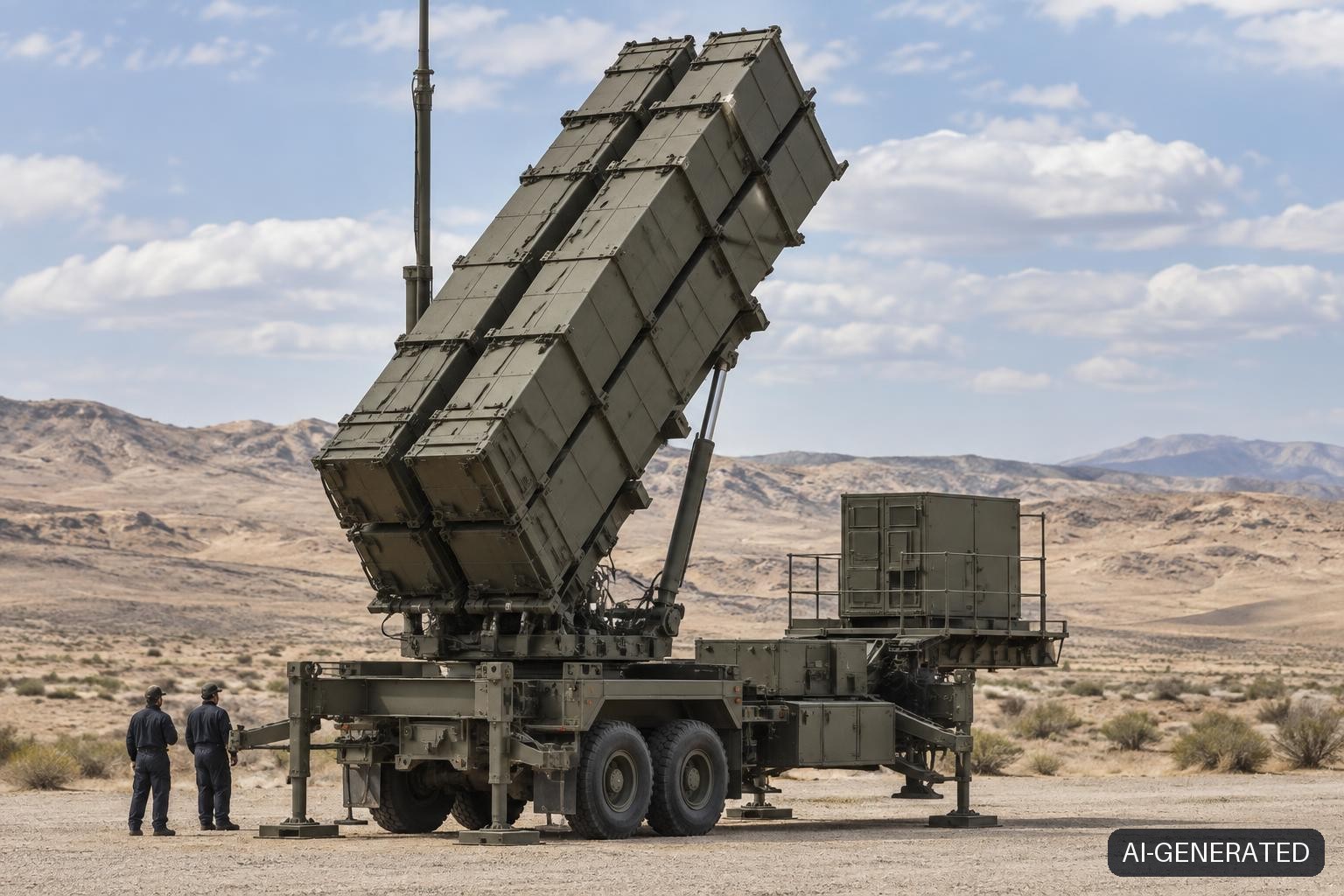
Lockheed Martin publicly unveiled the PAC-3 Edge on October 9, 2026, presenting its candidate for the U.S. Army's Innovative Future Interceptor (IFI) program as a purpose-built answer to the growing challenge posed by hypersonic and advanced missile threats. According to the company and reporting across Defense News, Military Times, Air Force Times, and Breaking Defense, the system is designed to fly farther and engage more capable targets than the current PAC-3 missile—a performance claim that frames the Edge not as an incremental refresh but as a step-change in what the Patriot family can intercept.
Lockheed Martin's investor relations announcement, published October 9 under the formal title "Lockheed Martin Debuts PAC-3 Edge™ for the U.S. Army's Innovative Future Interceptor Program," described the interceptor as a "next-generation Army interceptor" that "adds cutting-edge capability against hypersonic and advanced missile threats to the Arsenal of Freedom." The company's use of "debuts" in its own release title signals that October 9 was the system's first public appearance rather than a scheduled program update★. Defense News, Military Times, and Air Force Times each published coverage on October 10, corroborating the technical configuration Lockheed had released the day prior.
The PAC-3 Edge debut gives that pipeline a named system with named subcontractors★, setting a concrete reference point for Army program managers, Congressional staff, and allied operators as the IFI acquisition moves forward.
Technical Upgrades and Design Rationale
Three integrated improvements define the PAC-3 Edge relative to the existing PAC-3 Missile Segment Enhancement.★ Lockheed Martin describes a new seeker, upgraded flight controls, and a multi-pulse rocket motor provided by Northrop Grumman. Each addresses a distinct performance boundary of the current system. The same three-part technical description was cited consistently in reporting by Defense News, Military Times, and Air Force Times, all publishing on October 10 based on Lockheed's October 9 investor relations release.
The new seeker is the most operationally consequential upgrade.★ Lockheed has not disclosed detailed specifications for the Edge seeker in publicly available materials★, but the company's explicit positioning of the interceptor against the hypersonic threat class implies meaningful advances in sensitivity, processing speed, or both relative to what the current PAC-3 seeker provides★.
Upgraded flight controls are the second major design element. A more agile interceptor can execute sharper mid-course corrections, compensating for target track uncertainty during the engagement's most time-compressed phase. When combined with the seeker improvements, enhanced controls work in tandem to maintain intercept geometry against a target that may change course late in its terminal descent—precisely the behavior that makes advanced maneuvering missiles difficult to defeat with earlier-generation systems.
Northrop Grumman's multi-pulse rocket motor addresses the range and velocity requirements that hypersonic engagements impose.★ In operational terms, this supports intercepts at greater standoff distances, which becomes critical when threat systems are specifically engineered to minimize the defender's available reaction time. Northrop's role as the motor supplier brings a second major prime contractor into the PAC-3 Edge industrial team★, a structuring decision with implications for the program's congressional support base and its long-term sustainment posture★.
Program Context and Industrial Positioning
Lockheed unveiled the PAC-3 Edge explicitly as its offering for the Army's Innovative Future Interceptor program, the service's institutional vehicle for producing the next generation of Patriot-family interceptors. Breaking Defense's description of the system as Lockheed's "offering for the Army's future Patriot interceptor" characterizes the announcement in competitive terms, though neither that reporting nor Lockheed's investor relations release identified any competing offerors or described the IFI acquisition's competitive selection framework in detail. The Edge represents Lockheed's argument that the lineage can be extended once more, delivering hypersonic intercept capability within an architecture that Army units already operate and maintain, rather than requiring a clean-sheet system and the training and logistics investment that would accompany it.
Lockheed's official framing positions the PAC-3 Edge within what the company calls the "Arsenal of Freedom," situating the interceptor within broader U.S. deterrence strategy. That framing is marketing language, but the underlying operational logic is coherent: a more capable interceptor that integrates into existing Patriot fire unit infrastructure offers a lower transition burden and a shorter path to fielding than an entirely new system would. For the Army, which must balance modernization ambition against near-term readiness requirements, this continuity argument carries weight.
Breaking Defense reported that the company characterizes the Edge as capable of flying farther and hitting more capable targets than the current PAC-3—a claim that implies meaningful performance headroom without specifying precise range or engagement ceiling figures. Breaking Defense also described the system as Lockheed's "next-gen Patriot interceptor," language that echoes the company's own "next-generation Army interceptor" characterization from the investor relations release and consistently positions the Edge within the Patriot family lineage rather than as a departure from it. Those precise performance parameters are likely controlled at the program level and are unlikely to appear in public disclosures until developmental testing is underway. What the unveiling accomplishes is establishing the Edge as a named program with a named industrial team, which typically precedes formal contract activity by a relatively short interval in Army acquisition timelines.
Northrop Grumman's propulsion role is worth examining in the context of Grovewire's earlier reporting on solid rocket motor supply chain constraints affecting multiple U.S. defense programs. Whether the multi-pulse motor being developed for the Edge will face the same production rate constraints that have affected other solid rocket motor programs is not addressed in publicly available reporting, but it is a supply chain dimension the Army will need to account for as the IFI program matures.
However, Lockheed and the Army have not publicly addressed allied sales in the context of the PAC-3 Edge announcement, and that dimension remains outside the confirmed scope of the IFI program disclosure.
Milestones and Open Questions
The October 2026 unveiling is a concept and design disclosure, not a test flight or an engineering and manufacturing development contract award.★ No developmental test schedule has been confirmed in available public reporting, and the timeline from this announcement to Army operational fielding will depend on IFI program structure, budget authorization, and the results of qualification testing that the new seeker, upgraded flight controls, and multi-pulse motor will each require before an intercept demonstration can occur★. Any of those elements carries technical and schedule risk that the current announcement does not resolve.
Publicly available program documentation at this stage comprises Lockheed's October 9 investor relations release and the October 10 coverage from Defense News, Military Times, and Air Force Times, alongside Breaking Defense's concurrent reporting. None of those sources include Army program office statements on IFI acquisition structure, schedule, or competitive framework, leaving significant program details outside the public record at this stage.
What the unveiling does accomplish is giving the defense industrial community, allied partners, and congressional oversight staff a concrete system to evaluate as the IFI acquisition proceeds. The PAC-3 Edge is now a named interceptor with a defined capability claim and a named subcontractor supply chain, which is the necessary precondition for the formal competitive and budgetary processes that determine whether it moves to development. The Army's posture on competitive sourcing for the IFI program—and whether Lockheed will face a formal challenger for the award—has not been addressed in publicly available reporting at this stage.
★ AI inference: One or more analytical conclusions in this article were drawn by the AI from cited facts and are not directly stated in the cited sources.