
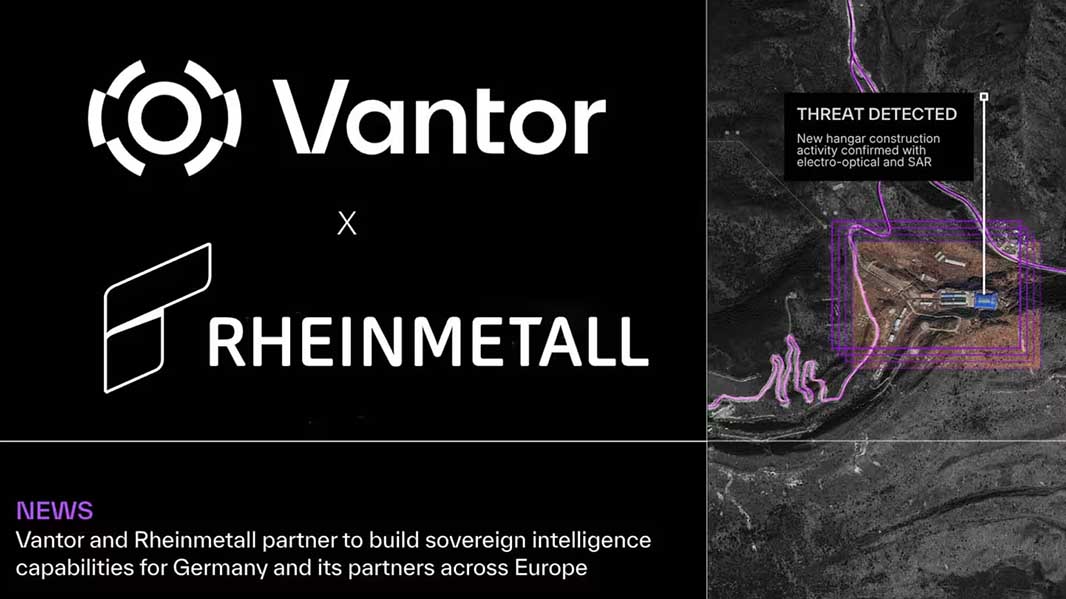
The agreement, announced on June 18, 2026, aims to advance what the companies describe as sovereign spatial intelligence capabilities — not just for Germany but potentially for other European nations as well. The venture is designed to deliver actionable intelligence to commanders and warfighters at the speed required for modern military operations.
Rheinmetall's Third Space Partnership in Months
For Rheinmetall, the Vantor MOU represents its third partnership in the military space domain within a relatively short period, according to Breaking Defense.
Sovereignty as the Core Rationale
The framing of the venture around sovereign capability is deliberate. European governments have grown increasingly wary of relying on allied or commercial providers for sensitive intelligence functions, particularly as geopolitical competition intensifies. By anchoring the joint venture to the Bundeswehr specifically, both Rheinmetall and Vantor are positioning themselves as primary suppliers in what Germany views as a strategically critical domain.
The venture is structured to provide intelligence outputs that meet operational timelines — meaning the system is intended not merely for strategic-level analysis but for integration into active military planning and command cycles. This operational tempo requirement points toward space-based platforms capable of near-real-time imaging or signals collection, though the companies have not detailed specific technical architectures at this stage★.
European Defense Investment in Space ISR
The Rheinmetall-Vantor announcement is one of several indicators that European defense investment in space-based ISR is accelerating. Major OEMs are increasingly treating space as a core domain rather than a peripheral capability, and governments are pushing procurement programs that emphasize national or allied control of the full intelligence chain — from collection through analysis to dissemination.
Whether the MOU translates into a formal joint venture with funded contracts will depend on subsequent negotiations and Bundeswehr procurement decisions. At this stage, the MOU signals intent and organizational alignment rather than a finalized commercial arrangement.
★ AI inference: One or more analytical conclusions in this article were drawn by the AI from cited facts and are not directly stated in the cited sources.