
The first days of July 2026 delivered an unusually concentrated sequence of orbital milestones. United Launch Alliance retired the Atlas 5 from payload-carrying service following an Amazon broadband mission; SpaceX added to its Starlink cadence and flew its seventeenth dedicated rideshare; SiriusXM took delivery of a heavy constellation-refresh spacecraft; China's Long March 10B completed its demonstration flight with a successful booster landing; and Austria formally contracted a second defense satellite. Individually, each item marks a discrete program step. Together, they reflect the accelerating investment cycle — across broadband LEO constellations, GEO communications, small-satellite rideshare, and defense smallsat procurement — that is defining the current industry moment.
Atlas 5 Closes Out on Amazon Leo Duty
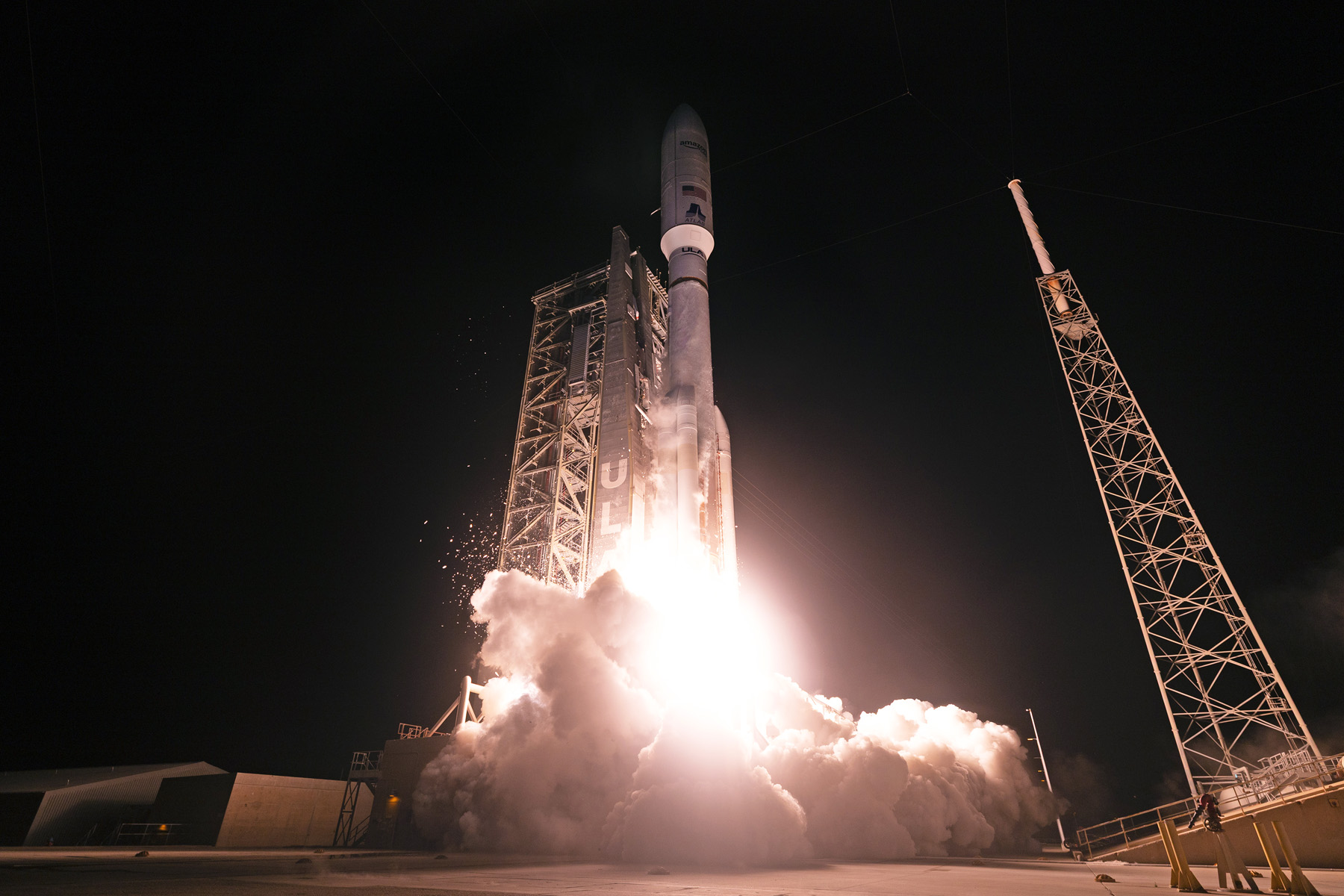
The Leo Atlas 8 mission lifted off from Space Launch Complex 41 at Cape Canaveral Space Force Station at 12:30:15 a.m. EDT on July 2, deploying a batch of Amazon Leo broadband satellites and formally ending the Atlas 5's career as a payload-carrying vehicle. SpaceNews confirmed the successful liftoff in its July 2 reporting, describing the mission as part of Amazon's broadband internet constellation development.
For ULA, the retirement closes a chapter on a rocket that served government and commercial customers for more than two decades and built one of the strongest reliability records in the industry. The Atlas 5's continued relevance for Amazon's LEO build-out illustrates how established vehicles remained competitive for broadband constellation deployment even as the industry moved toward reusable alternatives. The mission's designation — Leo Atlas 8 — indicates this was the eighth Atlas 5 flight in support of Amazon's LEO program★, a series that now concludes with the vehicle's retirement from payload duty. Amazon's remaining constellation launch requirements will need to be covered by other vehicles going forward; the sources available for this briefing do not specify which launchers are on contract for subsequent Amazon Leo missions.
From a market structure perspective, the Atlas 5 retirement reinforces the ongoing consolidation of the heavy and medium-lift launch market toward a smaller set of vehicles. The transition away from Atlas 5 had been anticipated for several years, but the final payload mission arriving as part of a commercial broadband constellation deployment underscores how central constellation programs have become to sustaining launch manifests in the near term.
SiriusXM, Starlink, and the Commercial Launch Cadence
Three days before the Atlas 5's final chapter, SpaceX launched SiriusXM's SXM-11 satellite from Cape Canaveral's pad 40 on June 28. The spacecraft weighs approximately 7.5 metric tons — among the heavier commercial GEO payloads to fly recently — and was manufactured by Intuitive Machines as part of SiriusXM's constellation refresh program. SXM-11's mass and the investment it represents point to SiriusXM's continued confidence in high-power GEO satellite audio broadcasting, even as the industry tracks competitive pressure from streaming and terrestrial alternatives.
On July 1, SpaceX launched 24 Starlink satellites on the Starlink 17-46 mission from Space Launch Complex 4E at Vandenberg Space Force Base, designating the flight as the 77th Falcon 9 launch of 2026. The mission is a routine addition to SpaceX's ongoing LEO constellation deployment — at that pace, SpaceX is tracking toward well over 100 Falcon 9 flights by year-end★. The relentless cadence of Starlink launches has practical implications for other operators seeking Falcon 9 manifest slots, and the rapid vehicle reuse that sustains SpaceX's schedule continues to function as a competitive benchmark that other launch providers are working to approach.
Transporter 17 launched July 7 from Vandenberg's SLC-4E, extending SpaceX's dedicated rideshare program into its seventeenth mission. The flight delivered dozens of microsatellites and nanosatellites for commercial and government customers to a sun-synchronous orbit, according to the Launch Library 2 record. The Transporter series has become a reliable secondary route to SSO for small operators who cannot justify dedicated launches, and the ongoing presence of government payloads aboard demonstrates that the rideshare infrastructure is viable for at least some national-interest missions.
Long March 10B Achieves China's First Booster Recovery
The Launch Library 2 record for the mission marks it as successful and describes it as the first ever successful booster recovery by a Chinese launch vehicle — a milestone that Chinese launch providers and their government backers have been working toward as SpaceX's Falcon 9 reuse model has reshaped launch economics globally. The mission was operated by China Aerospace Science and Technology Corporation.
Payload details for the demo flight have not been disclosed; the mission record lists the payload as TBD, consistent with a test-focused flight where demonstrating vehicle performance and booster recovery is the primary objective. Whether booster reuse is planned as a production feature for the Long March 10B's commercial or government manifest, or remains in a technology demonstration phase, is not detailed in available sources. The Long-term commercial implications depend on how rapidly the 10B's reuse capability can be operationalized and at what turnaround cadence and cost — both unknowns at this stage. What the July 10 flight does establish is that China has now demonstrated the core technical capability, removing a key uncertainty about whether Chinese launch vehicles could achieve booster recovery at all.
Austria Contracts R-Space for Second Military Satellite
Aurora is part of a series of three government-backed demonstration missions that Austria is using to validate new technologies in orbit — a structured, incremental approach to building sovereign space capability rather than a single large-platform procurement. The program's architecture, spanning three sequential demonstrations, reflects a deliberate strategy to develop and mature technology progressively while managing risk and cost.
R-Space is among a growing tier of European smallsat manufacturers that have benefited from national defense agencies seeking to establish or expand domestic satellite capacity without the lead times and costs associated with large traditional GEO defense platforms. Austria's trajectory — two military satellites within a relatively short period, with a third planned in the demonstration series — is representative of a broader pattern in which mid-sized European states are moving from being primarily consumers of allied satellite services toward operators with at least a partial sovereign orbital capability. The Aurora procurement also provides R-Space with a continued anchor customer relationship and a validated government reference mission, which carries commercial value in a competitive smallsat manufacturing market.
★ AI inference: One or more analytical conclusions in this article were drawn by the AI from cited facts and are not directly stated in the cited sources.