
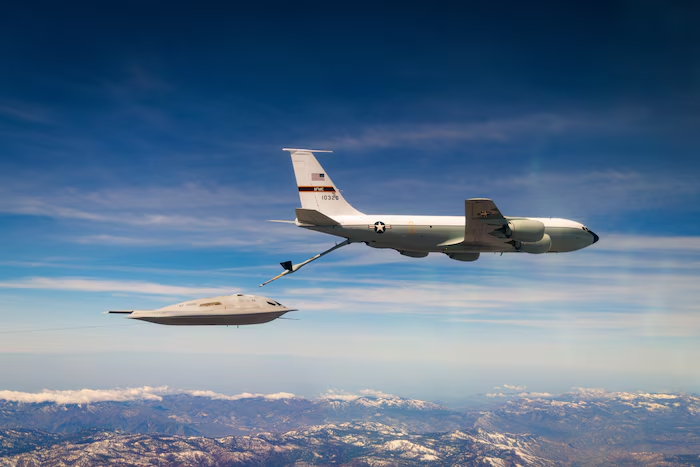
The U.S. Air Force is nearing the end of a market research effort aimed at adding active self-defense weapons to its tanker aircraft — a significant potential departure from how large, non-combat platforms have traditionally been protected. According to Air & Space Forces Magazine, the service awarded contracts to four industry firms beginning in February 2026 to study options for equipping refuelers like the KC-135 Stratotanker and KC-46 Pegasus with systems capable of shooting down incoming enemy missiles.
The initiative reflects mounting concern within the service about the vulnerability of high-value airborne assets in contested airspace. Kevin Stamey, the Air Force's Program Executive Officer for Mobility, articulated the core challenge: the threat environment is evolving fast enough that the service wants a protection capability that isn't pegged to countering any single specific threat. Stamey confirmed the Air Force is evaluating "kinetic self-protection" systems — effectively hard-kill interceptors, sometimes described as mini missiles — that would engage incoming threats inside the weapons engagement zone before they can reach the aircraft.
The concept extends beyond tankers alone. Army Recognition reported that Stamey's comments encompassed a broader set of mobility platforms, including the C-17A, C-130, and C-5M transport aircraft.
From Passive to Active Protection
The active defense concept under study represents a harder edge of that spectrum, seeking to intercept and destroy threats kinetically. But applying it to logistics and refueling aircraft would mark a notable expansion.
The Air Force is described as quietly wrapping up this round of market research as of early July 2026, suggesting the service will soon decide whether to advance the concept into a formal development program. While contracts for study-phase work are common precursors to acquisition programs, they do not guarantee a fielding decision — the research may surface cost, weight, or integration challenges that reshape or delay the effort. No timeline for a potential fielding decision was made available in the sources reviewed.
The broader signal, however, is clear: the Air Force is increasingly treating fleet survivability — not just for fighters and bombers, but for the logistics aircraft that enable them — as an active design requirement rather than an afterthought.