
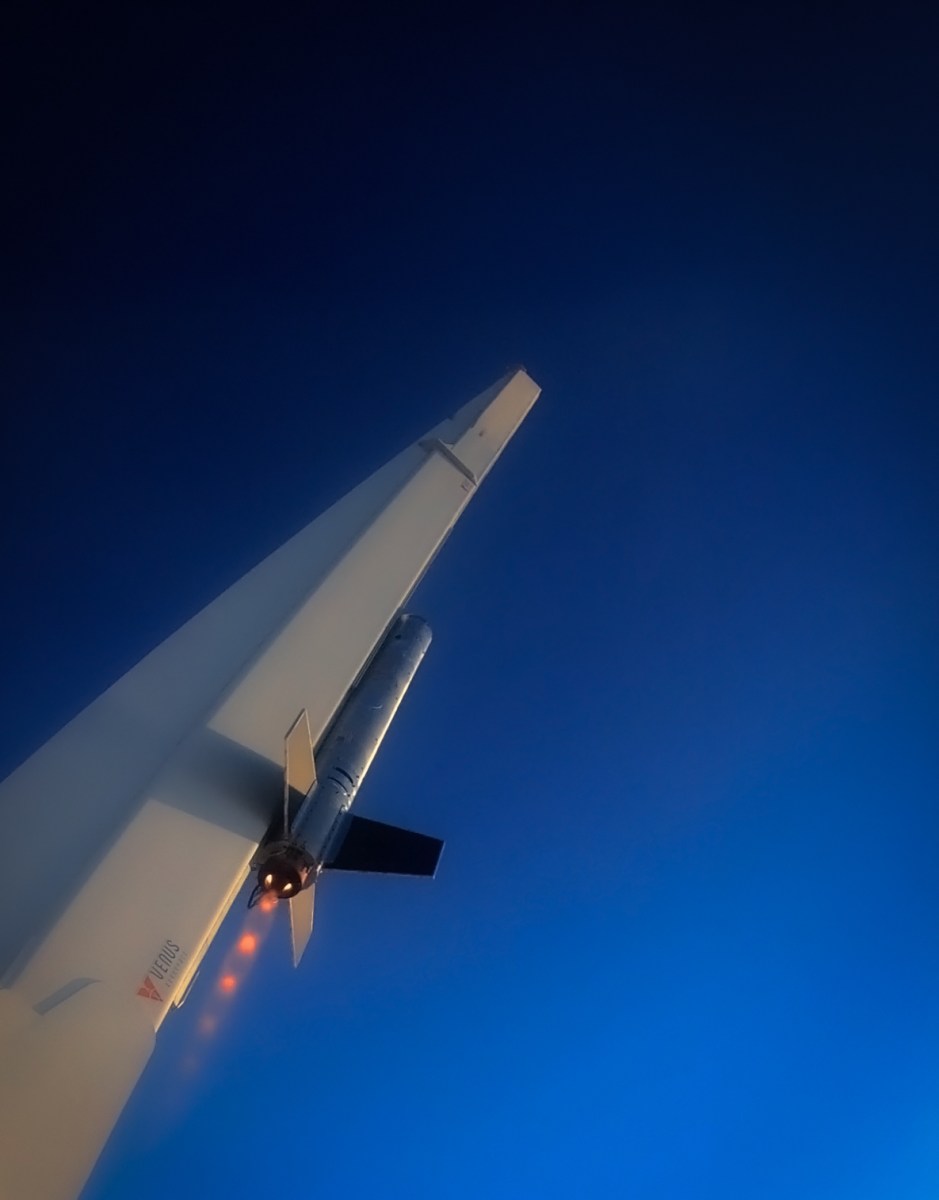
Venus Aerospace has closed a $91 million Series B funding round to accelerate development and production of its rotating detonation rocket engine (RDRE), a propulsion technology that promises meaningfully greater efficiency than conventional rocket engines. The round was announced July 8, 2026, and was reported across multiple outlets including SpaceNews, Defense Daily, Payload, and Space.com.
The capital infusion comes on the heels of a significant technical milestone: the company conducted successful RDRE flight tests in 2025, moving the technology from ground demonstration into an airborne environment★. Those results gave investors confidence that the engine design is viable beyond the lab★, and the new funding is intended to carry Venus Aerospace from testing into scaled manufacturing across several use cases.
What Makes the RDRE Different
That efficiency advantage is the core commercial and strategic appeal of the technology. For launch operators — including those serving defense customers who require rapid or responsive space access — a more efficient engine translates directly into payload capacity, cost per kilogram to orbit, or both.
Defense Daily's coverage of the round underscored the military relevance of the work★. The ability to field a next-generation engine at production scale matters as much as the performance on paper: a technology that remains stuck in prototype form has limited operational value.
Industry Momentum
Venus Aerospace is not operating in isolation. Payload noted that the funding round is the latest in a series of moves by RDRE-focused companies, characterizing the current period as a notable inflection point for the technology sector★. Multiple firms are now competing to demonstrate that rotating detonation propulsion can transition from a promising research concept into a reliable, manufacturable product★.
Space.com reported that Venus Aerospace plans to apply its engine designs across multiple application areas, suggesting the company sees a market that extends beyond any single rocket or mission profile. Whether that includes upper-stage propulsion, small-launch vehicles, or hypersonic applications is not fully detailed in available reporting, but the multi-application framing signals an intent to build a broadly deployable propulsion platform rather than a one-off demonstrator.
With $91 million now in hand and a 2025 flight test record to build on, Venus Aerospace enters the second half of 2026 with the resources needed to pursue production-readiness — the phase where many advanced propulsion programs have historically stalled.
★ AI inference: One or more analytical conclusions in this article were drawn by the AI from cited facts and are not directly stated in the cited sources.