
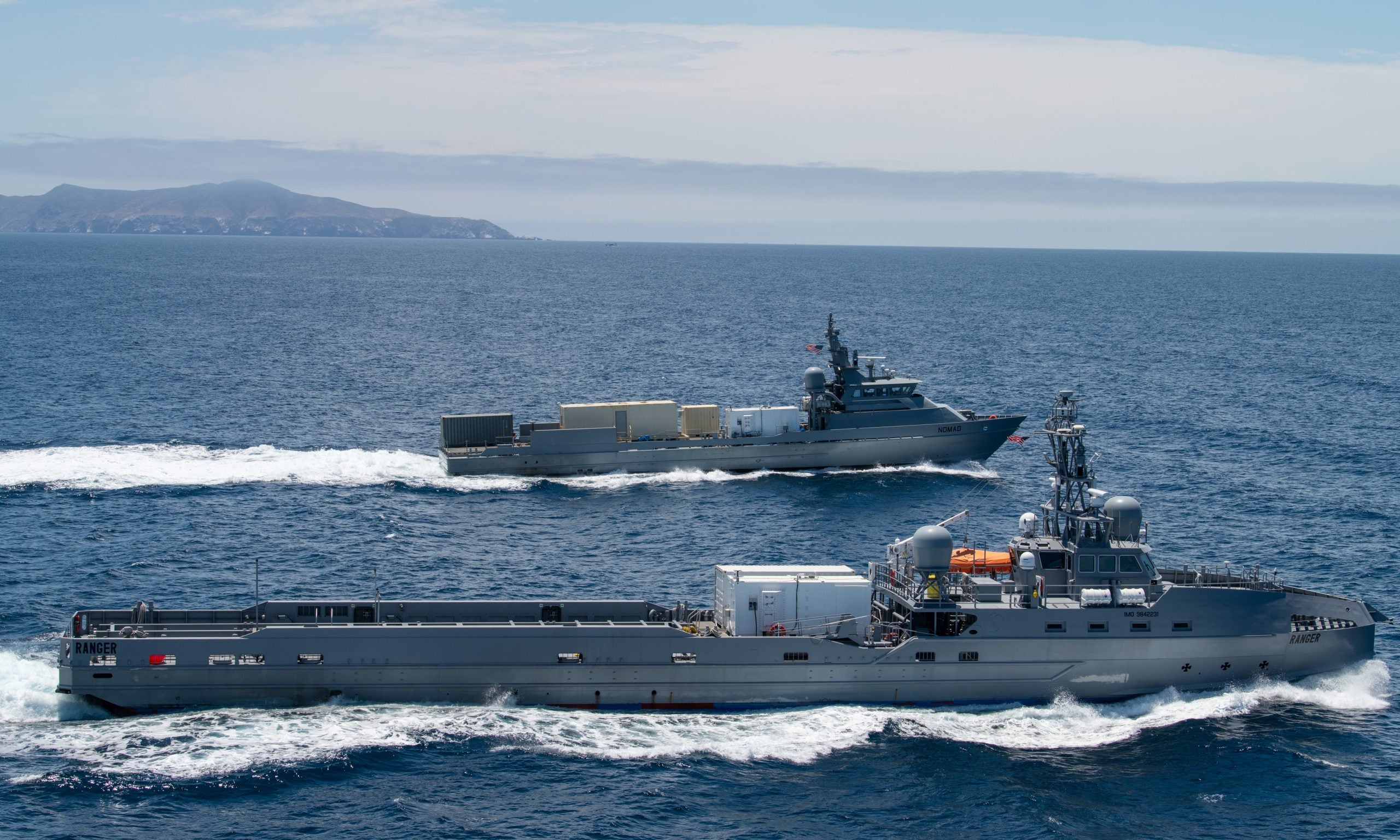
The Defense Innovation Unit (DIU) and the U.S. Navy have jointly launched a new competition to speed the development of containerized payloads for military platforms. The challenge, called Specular MIST, carries a $5 million prize pool and is structured as a multiphase competition designed to draw in industry solutions for modular systems that can be fitted to a range of naval vessels.
The initiative reflects a strategic posture shift that Chief of Naval Operations Adm. Daryl Caudle began formalizing in March 2026, when he kicked off what the Navy has described as a "containerized capability campaign plan." The campaign's central premise is that modular, containerized weapons and payloads can be rapidly adapted to existing ships for specific combat operations — without the costly, time-consuming overhauls traditionally required to integrate new capabilities onto naval platforms. For a fleet under pressure to modernize quickly and stretch capacity across a wider range of missions, the approach offers a path to expanding what individual ships can do without waiting years for purpose-built solutions.
A Competition to Drive Development
The Specular MIST challenge, opened by DIU in early July 2026, targets the development of containerized payloads for both manned and unmanned platforms. By running the effort as a prize competition rather than a traditional acquisition program, DIU and the Navy are betting that competitive incentives and a streamlined structure will bring in a broader field of developers and compress timelines. The $5 million prize pool is intended to reward solutions that meet defined performance criteria across the challenge's phases★.
The competition is a direct operational expression of Caudle's campaign, which has been building since the CNO outlined the concept earlier this year. Rather than treating containerization as a niche or experimental concept, the Navy appears to be institutionalizing it — using the Specular MIST challenge to generate a pipeline of field-ready modular systems and establish standards that could apply across the fleet.
The broader logic of containerized payloads is straightforward: standardized form factors mean a sensor package, weapon system, or electronic warfare module designed for one platform can, in principle, transfer to another without bespoke engineering work★. That flexibility is increasingly attractive as the Navy seeks to distribute capability across more hulls and respond to emerging threats faster than traditional procurement cycles allow★. Whether the Specular MIST competition delivers solutions that meet that promise at scale remains to be seen, but the joint DIU-Navy structure signals that this is now an institutional priority rather than a research project.
★ AI inference: One or more analytical conclusions in this article were drawn by the AI from cited facts and are not directly stated in the cited sources.