
SpaceX suffered two notable launch failures within a single week in mid-July 2026, a stretch that tested the company's reliability story just as it continues building out both its own Starlink internet megaconstellation and an increasingly important slice of the U.S. military's space architecture.
On July 20, a Falcon 9 carrying 24 Starlink satellites aborted at the last second from Pad 4E at Vandenberg Space Force Base — the kind of rare, terminal-count scrub that SpaceX's normally smooth operations rarely produce. The Starlink 17-39 mission was slated to be the company's 85th Falcon 9 launch of 2026. Four days earlier, on July 16, Starship Flight 13 ended on the pad at Starbase, Texas, when four Raptor engines failed to ignite, triggering an automatic abort before the vehicle ever left the ground. The flight was intended to deploy the first Starlink V3 satellites on a suborbital trajectory and to validate a package of reusability improvements.
Military Work Continues Despite Setbacks
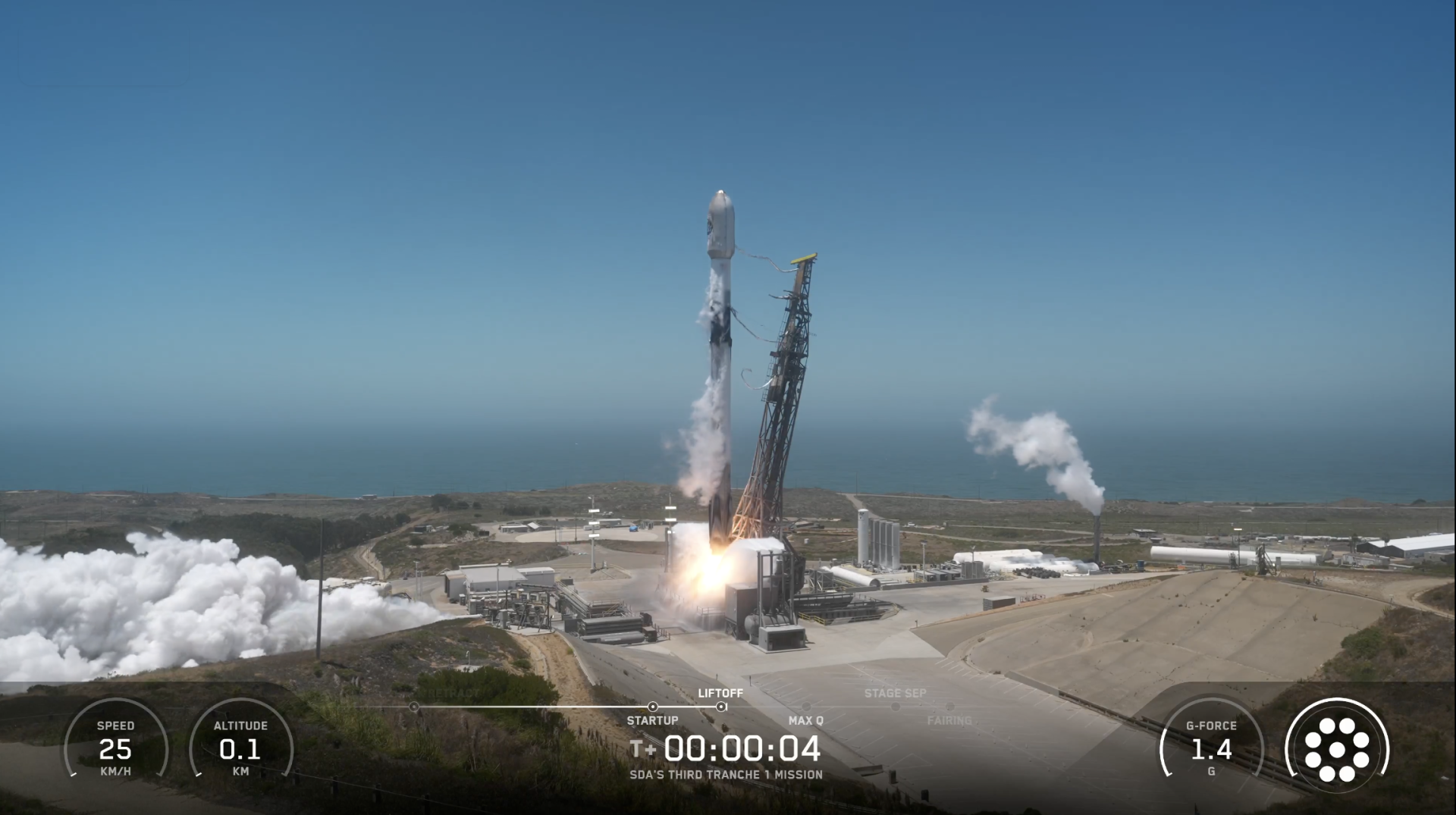
Also on July 16 — the same day as the Starship abort — SpaceX successfully launched 21 communications satellites for the Space Development Agency aboard a Falcon 9 from Vandenberg. The Tranche 1 Transporter Layer E (T1TL-E) mission was the third operational batch delivered to the SDA's Proliferated Warfighter Space Architecture (PWSA) constellation. The launch came after the SDA had been forced to suspend its planned monthly PWSA deployment schedule due to technical issues, making the successful delivery particularly significant for program managers trying to restore cadence to the constellation buildout.
The juxtaposition is hard to miss: the same launch provider carrying the Pentagon's PWSA ambitions forward also had an engine failure abort on the same calendar day, across a different vehicle. For military customers, SpaceX's role as essentially the only U.S. launch provider operating at scale creates a structural dependency. When anomalies cluster — even across different vehicle types — they concentrate scrutiny on whether SpaceX's tempo introduces systemic risk.
Unprecedented Pace, Mounting Data Points
The volume of activity makes context essential. On July 13 alone, SpaceX flew two Falcon 9 missions: one from Cape Canaveral that deployed 29 Starlink satellites and marked the 600th flight of a reused Falcon booster, and a second from Vandenberg that placed 27 more Starlink satellites into orbit. Two successful launches in a single day from opposite coasts underlines how deeply routine Falcon 9 operations have become — which is precisely why a last-second abort registers as a meaningful data point rather than background noise.
The Starship situation is different in character. The vehicle is still in a test program, and abort systems functioning as designed during an engine anomaly is the system working correctly. Still, four Raptor engines failing to ignite on what was supposed to be Flight 13 keeps pressure on the program's timeline and on SpaceX's ambitions to use Starship as a next-generation Starlink deployment platform.
For the SDA and other government customers, the near-term operational reality remains Falcon 9, which by any historical measure is an extraordinarily reliable rocket. The aborts of mid-July — one terminal scrub, one pad abort — represent anomalies against a backdrop of dozens of successful flights. Even so, as the military becomes more reliant on SpaceX to sustain and expand the PWSA at pace, the margin for disruption narrows.