
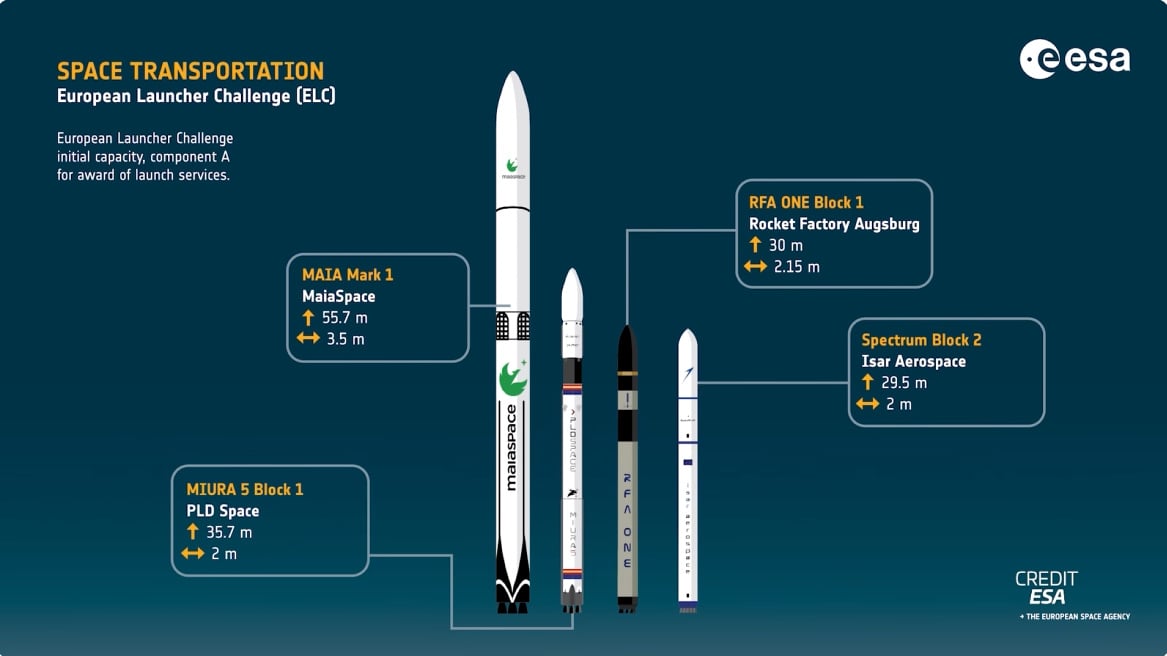
The European Space Agency has taken a concrete step toward reducing the continent's dependence on foreign launch services, signing the first contracts under its European Launcher Challenge program and committing a combined €543.6 million to three commercial providers.
RFA will receive €186.9 million, a share largely funded by Germany with an additional contribution from the United Kingdom. The full breakdown across all three awardees reflects a broader model of member-state co-investment in emerging European launch companies — an approach that blends national priorities with ESA's institutional backing.
A Program Designed to Build a Competitive Launch Market
The strategic dimension is hard to separate from the commercial one. European governments and defense planners have grown increasingly focused on assured access to space — the ability to place satellites in orbit without relying on launch infrastructure controlled by non-European entities. The Launcher Challenge contracts, while framed as commercial investment, directly address that vulnerability by funding domestic alternatives with dedicated government support.
MaiaSpace Left Out of First Tranche
ESA said the contract award process with MaiaSpace is "expected to resume in the coming weeks," suggesting the company remains in consideration but did not complete negotiations in time to be included in this first tranche★.
Whether MaiaSpace joins them in subsequent contract rounds will be a key indicator of how broadly ESA intends to distribute its Launcher Challenge commitments.
★ AI inference: One or more analytical conclusions in this article were drawn by the AI from cited facts and are not directly stated in the cited sources.