
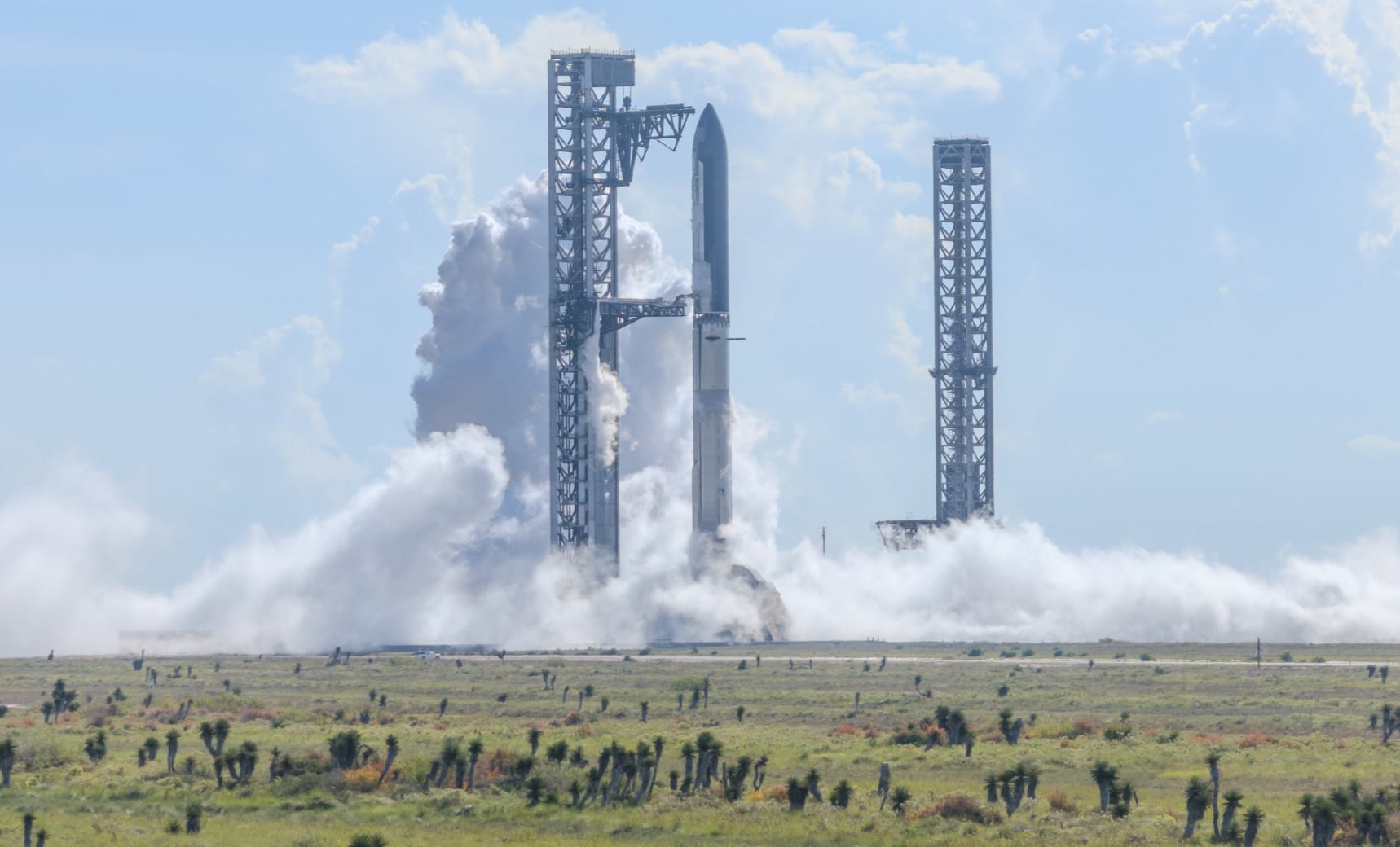
SpaceX has cleared Starship Flight 14 for launch following the completion of key pre-flight testing at Starbase in Texas, with the mission carrying a net earliest time of September 28, 2026, from Orbital Launch Pad 2. Designated Starlink Group 31-1, the mission carries a commercial communications payload—a batch of Starlink satellites—making it the first Starship flight to attempt in-orbit satellite deployment. For a program that has been building toward orbital capability through thirteen prior test missions since the integrated vehicle's inaugural flight in April 2023, Flight 14 marks the point at which demonstration begins to converge with operational utility.
From Development Program to Orbital Test Flight
Flight 14 is formally characterized as the first intended orbital mission in Starship's test sequence, a distinction that separates it from the thirteen flights that preceded it. Spaceflight Now describes it as the planned first orbital test flight since the integrated rocket began launching in April 2023—a framing that underscores how long the path from first integrated liftoff to orbital attempt has been, even as each preceding mission steadily expanded the demonstrated flight envelope.
The mission is the third flight of the Starship V3 configuration, which represents a more mature hardware generation than the early prototype vehicles. The target orbit is low Earth orbit, and the payload is Starlink Group 31-1—a communications satellite group consistent with ongoing Starlink constellation operations. The decision to combine an orbital demonstration with an operational payload deployment reflects SpaceX's approach of using commercial missions to validate development milestones rather than maintaining a strict separation between test and operational flights.
NASASpaceFlight.com notes that Flight 14 has been framed explicitly against Starship's forward operational roadmap, with a near-term manifest already pointing to subsequent missions. That manifest signals that SpaceX is beginning to plan Starship as a recurring launch service rather than a purely experimental program. While the specific contents of that manifest are not detailed in the available reporting, its existence at this stage is meaningful: manifest planning of this kind requires sufficient confidence in vehicle reliability and launch cadence to commit downstream customers and mission planners to schedules.
The transition from suborbital test flights to orbital operations is not merely a technical threshold—it is a commercial and programmatic one. A vehicle that reaches orbit and successfully deploys a payload has demonstrated the core functional requirements for commercial satellite launch. For Starship, clearing that bar with a Starlink deployment mission also establishes in-house operational continuity between SpaceX's launch vehicle program and its largest internal customer, the Starlink constellation, which requires ongoing expansion to maintain competitive service coverage.
Hardware Readiness: Ship 41 and Booster 21
The physical status of the Flight 14 stack progressed through SpaceX's pre-flight verification sequence ahead of the launch date. As NASASpaceFlight.com reported on September 23, Booster 21 and Ship 41 were stacked at the launch site as of early morning that day, indicating that major integration operations had concluded ahead of the final countdown period.
Spaceflight Now confirms the hardware assignments: Ship 41 serves as the upper stage and Booster 21 as the first stage. These designations reflect SpaceX's serial production model for Starship, in which vehicle components are built, tested, and designated individually before integration into a complete launch stack. Both Ship 41 and Booster 21 fall within the V3 configuration category★, placing them among the more recent production hardware SpaceX has fielded under the Starship program.
The confirmed completion of this milestone is therefore a meaningful indicator of readiness, separate from the formal launch authorization itself.
Orbital Launch Pad 2 at Starbase is the designated launch facility for Flight 14. Multiple pads are an enabler of the cadence SpaceX will need to achieve if Starship is to mature into a commercially viable, high-frequency launch vehicle—particularly one supporting constellation replenishment operations that demand predictable scheduling.
A Decade of Development
NASASpaceFlight.com frames Flight 14 explicitly against a development timeline spanning more than a decade in many forms. The current integrated two-stage architecture—Super Heavy booster plus Ship upper stage—represents a departure in scale and ambition from
The integrated vehicle began test flights in April 2023, opening a period of iterative envelope expansion across thirteen missions. By Flight 14, the cumulative demonstrated capability is sufficient not only to attempt orbit but to attempt payload delivery in orbit★—a substantive operational threshold that separates the vehicle from its test program predecessors.
For the U.S. launch industry, That structural characteristic is relevant for customers whose requirements scale with delivered mass—including, in principle, Department of Defense programs requiring large-aperture deployments or on-orbit assembly campaigns—though no specific government contracts or mission assignments are reflected in the current source material. The relevance at this stage is structural rather than programmatic.
Forward Manifest and the Broader Launch Landscape
The period surrounding Flight 14 illustrates the density of SpaceX's current operations across its vehicle portfolio. Crew-13, the thirteenth crewed operational flight of a Crew Dragon spacecraft to the International Space Station under NASA's Commercial Crew Program, is scheduled for launch from Space Launch Complex 40 at Cape Canaveral around October 1, 2026, using a Falcon 9 Block 5. NASASpaceFlight.com's September 24 ISS roundup captures Expedition 75 crew members conducting ongoing science operations aboard the station as Crew-13 preparations proceed—illustrating that ISS human spaceflight operations continue on their own cadence, independent of the Starship test program's milestones.
The parallel timelines of Crew-13 and Starship Flight 14 offer a concrete view of SpaceX managing multiple vehicle programs simultaneously: Falcon 9 commercial crew operations at Cape Canaveral and a Starship orbital debut at Starbase in Texas. That concurrency is a practical reference point for evaluating how Starship's eventual high-cadence ambitions might integrate with the company's existing operational commitments across launch sites and vehicle types.
For industry planners and government customers, the near-term manifest taking shape behind Flight 14 will be a primary signal to monitor in the months ahead. How quickly SpaceX cycles from Flight 14 to subsequent orbital missions, and what payload types appear on that manifest, will determine the pace at which Starship transitions from a program under close observation to one actively serving the commercial and institutional launch market. The Flight 14 launch window, targeting the final days of September 2026, is the immediate and most concrete inflection point in that progression—and the first real test of whether the full operational sequence, from liftoff through payload deployment, performs as the test program has been designed to enable.
★ AI inference: One or more analytical conclusions in this article were drawn by the AI from cited facts and are not directly stated in the cited sources.